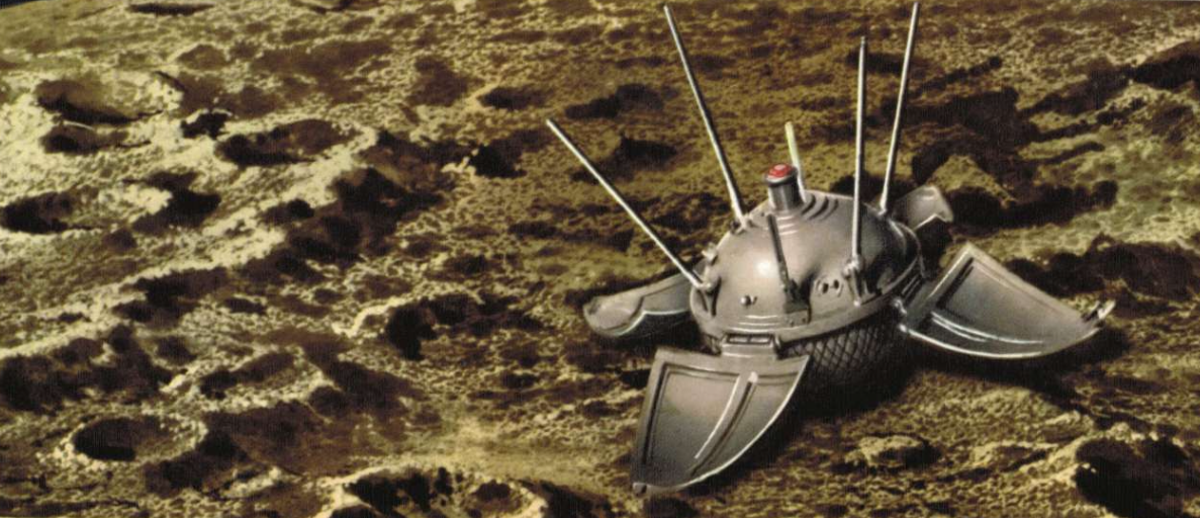
"Humanity's first successful lunar lander is missing. Sixty years ago the Soviet Luna 9 became the first human-made object to achieve a soft landing on the moonor, for that matter, any celestial body. Yet today its exact location remains a mystery. While NASA's Lunar Reconnaissance Orbiter (LRO) and India's Chandrayaan-2 have mapped nearly the entire lunar surfacecapturing the Apollo landing sites and Soviet rover tracks in exquisite detailLuna 9 has eluded detection."
"Luna 9 was a product of the second generation of Soviet lunar probes, a program designated Ye-6. The road to success was paved with failure: 11 previous Ye-6 launches ended prematurely as a result of rocket malfunctions, booster failures or orientation system errors. Success finally came on the 12th attempt. On February 3, 1966, the spacecraft touched down in Oceanus Procellarum (the Ocean of Storms)."
Luna 9 achieved the first human-made soft landing on the Moon on February 3, 1966, touching down in Oceanus Procellarum. Its exact landing site remains undetected because the spacecraft is too small for current orbital cameras to easily distinguish from surrounding lunar rubble. NASA's LRO and India's Chandrayaan-2 have imaged nearly the entire surface, yet Luna 9 eluded clear identification. International researchers using machine-learning and manual open-source intelligence have identified several promising candidate sites. Deeper scrutiny by Chandrayaan-2 could potentially confirm one of those candidates. Luna 9 belonged to the Ye-6 program, which succeeded after eleven prior failures.
Read at www.scientificamerican.com
Unable to calculate read time
Collection
[
|
...
]