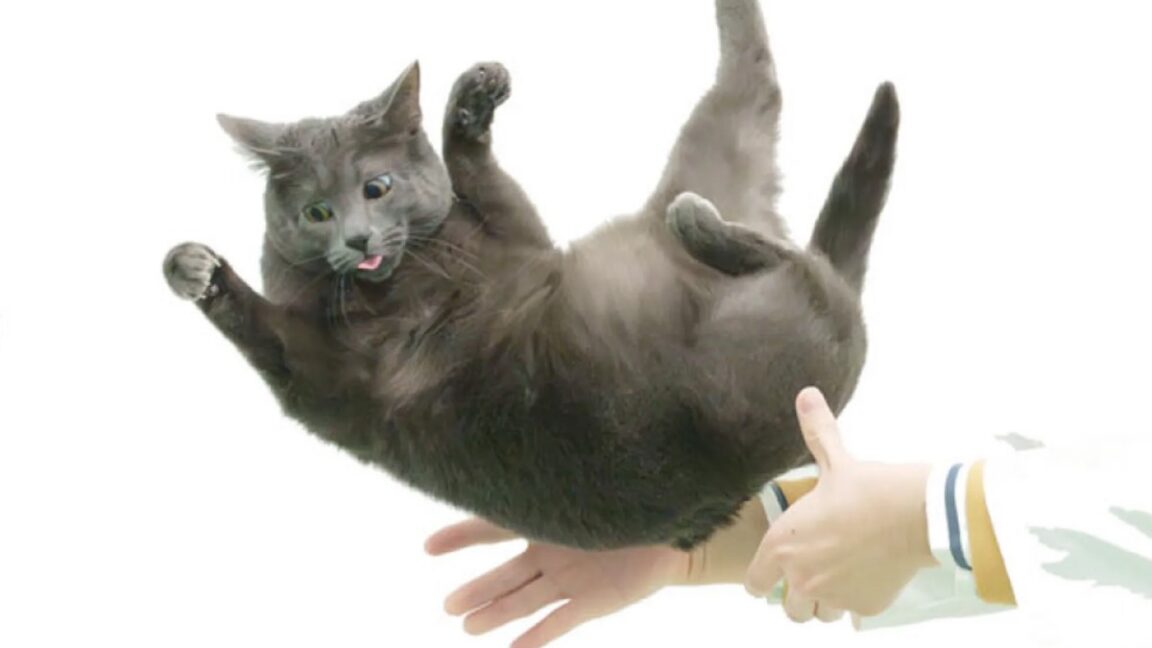
Scientists have investigated the cat righting reflex for over three centuries, with research continuing through modern experiments analyzing feline spinal flexibility. Early observations suggested cats in free fall could not rotate, but high-speed photography in 1894 revealed they consistently land on their feet. Four primary hypotheses explain this phenomenon: the tuck-and-turn model involving paw manipulation, the falling figure skater approach using angular momentum adjustments, the bend-and-twist mechanism with waist rotation, and the propeller tail hypothesis. Current research indicates the bend-and-twist motion serves as the fundamental mechanism, supplemented by fine adjustments from limb positioning and tail rotation.
"For a long time, scientists believed that it would be impossible for a cat in free fall to turn over. That's why French physiologist Etienne-Jules Marey's 1894 high-speed photographs of a falling cat landing on its feet proved so shocking to Marey's peers. But Gbur has emphasized that cats are living creatures, not idealized rigid bodies, so the motion is more complicated than one might think."
"Over the centuries, scientists have offered four distinct hypotheses to explain the phenomenon. There is the original 'tuck and turn' model, in which the cat pulls in one set of paws so it can rotate different sections of its body. Nineteenth-century physicist James Clerk Maxwell offered a 'falling figure skater' explanation, whereby the cat tweaks its angular momentum by pulling in or extending its paws as needed."
"When one goes through the math, that seems to be the most fundamental aspect of how a cat turns over. But there are all these little corrections on top of that."
#cat-righting-reflex #feline-biomechanics #physics-of-falling #animal-locomotion #scientific-research
Read at Ars Technica
Unable to calculate read time
Collection
[
|
...
]