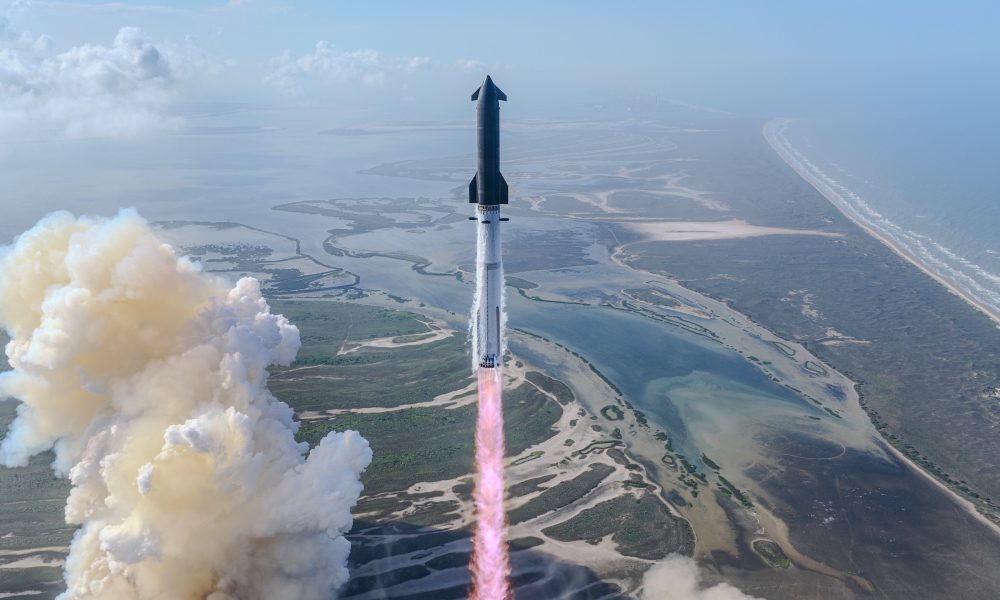
Starship V3 launched on May 22 from Pad 2 at Starbase, Texas, after two scrubbed attempts. The Super Heavy booster lost an engine early during ascent and several more during the boostback burn, leading to an off-nominal descent and a hard landing in the Gulf of Mexico. The planned outcome for this first V3 flight allowed booster loss because a soft splashdown was expected rather than a tower catch. The Starship upper stage reached its planned sub-orbital trajectory despite losing one vacuum Raptor engine, with remaining engines compensating. The vehicle survived atmospheric reentry, performed a belly-flip, and splashed down upright in the Indian Ocean west of Australia. Flight 12 deployed 22 payload objects, including 20 Starlink simulator satellites and two camera-equipped satellites that scanned the heat shield from orbit and transmitted imagery for rapid inspection and certification between future flights.
"The Super Heavy booster lost an engine early during ascent and several more failed during its boostback burn, sending the stage into an off-nominal descent that ended in a hard landing in the Gulf of Mexico. SpaceX had planned a soft splashdown rather than a tower catch on this first V3 flight, so losing the booster was expected to be acceptable within the test parameters."
"Ship 39 told a different story. The Starship upper stage reached its planned sub-orbital trajectory despite losing one of its vacuum Raptor engines, with the remaining engines compensating for the loss and keeping the vehicle on course. The spacecraft then survived atmospheric reentry, completed its belly-flip maneuver, and made a controlled upright splashdown in the Indian Ocean west of Australia."
"The payload test is where Flight 12 separated itself from every previous Starship mission. SpaceX deployed 22 objects including 20 Starlink simulator satellites sized like next-generation V3 Starlink units, plus two specially modified satellites equipped with cameras that scanned Starship's heat shield from orbit and transmitted imagery back to operators."
"Every future Starship deployment, whether it is a batch of operational Starlink V3 satellites, cargo bound for the Moon, or eventually crew headed to the first human Moon landing since 1972, depends on SpaceX being able to inspect and certify the heat shield quickly between flights. The camera-equipped satellites deployed on Flight 12 are the first step toward making that inspection process au"
Read at TESLARATI
Unable to calculate read time
Collection
[
|
...
]