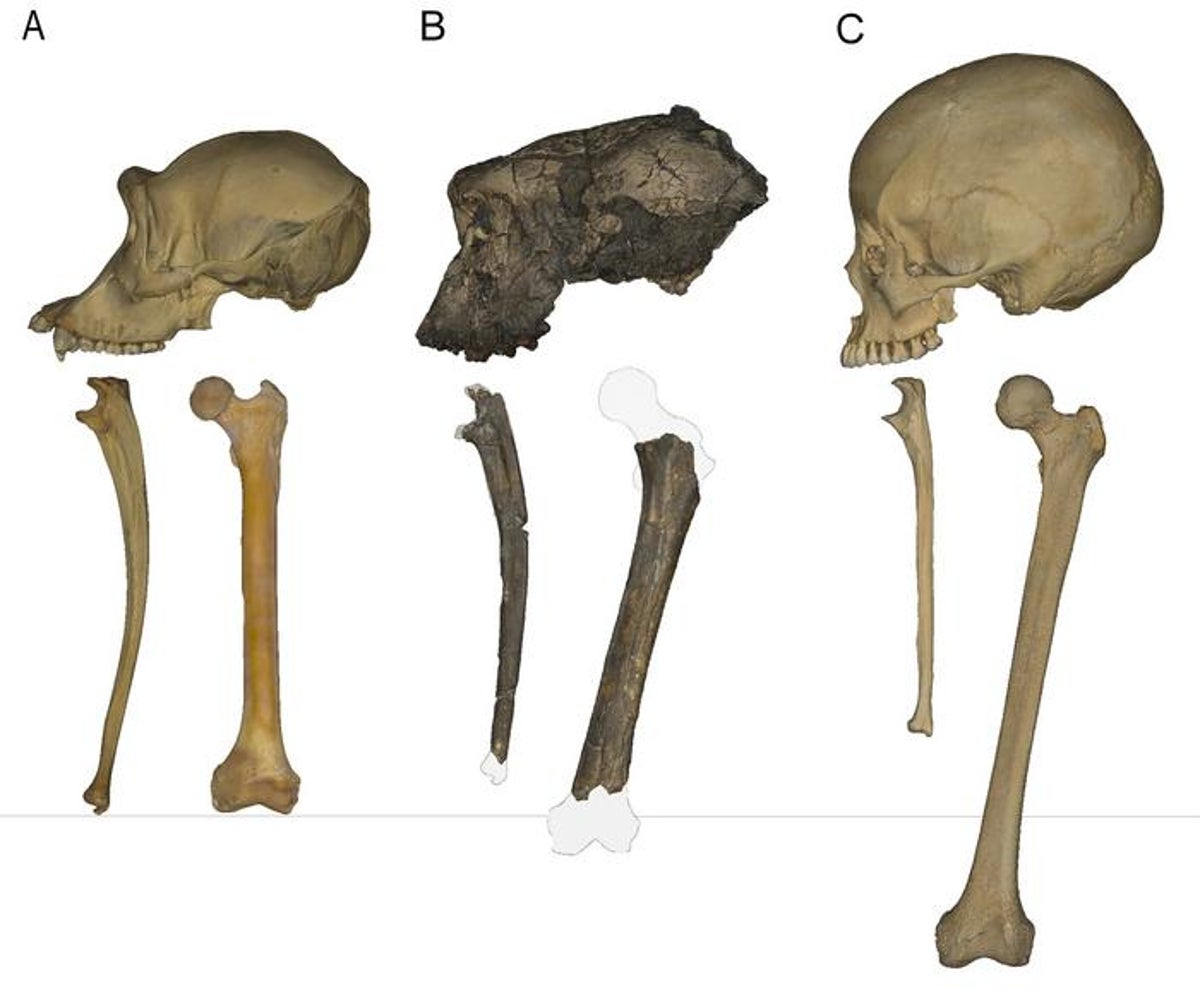
"Aside from our big brains, the trait that most distinguishes humans from other animals is our ability to walk fully upright on two legs, a style of movement without parallel in the animal kingdom. But exactly when our ancient ancestors evolved this trait was a mysteryuntil now. A new fossil analysis suggests that the earliest-known hominin had begun to evolve adaptations for bipedalism."
"Sahelanthropus tchadensis lived in north-central Africa seven million years ago, right when the hominin lineage split off from that of our nearest animal relatives, chimpanzees and bonobos. When anthropologists discovered the first Sahelanthropus skull fragments in Chad in 2001, they immediately wondered whether it was bipedalthe hole at the base of its skull where the spinal cord would have entered seemed well positioned to carry its head, as in other bipeds. But with only a partial cranium, there wasn't much to go on."
"Researchers later realized that a femur found alongside the skull fragments belonged to the hominin, but when it was first analyzed, researchers saw no evidence for bipedalism. Those findings, published in 2020, contradicted the earlier hypothesis and raised doubts as to whether the species should be considered a hominin at all. The field is kind of split right now on how to interpret these fossils, says Scott Williams, a paleoanthropologist at New York University, who co-authored the new analysis."
Sahelanthropus tchadensis lived in north-central Africa about seven million years ago at the time the hominin lineage diverged from chimpanzees and bonobos. Initial skull fragments discovered in Chad in 2001 suggested a skull base positioned to carry the head as in bipeds, but a partial cranium limited conclusions. A femur found with the skull was later analyzed and initially showed no evidence for bipedalism, producing contradictory 2020 findings and debate over hominin status. More recent work using three-dimensional geometric morphometrics identifies rudimentary features consistent with early bipedal adaptations, reversing the earlier narrative.
Read at www.scientificamerican.com
Unable to calculate read time
Collection
[
|
...
]