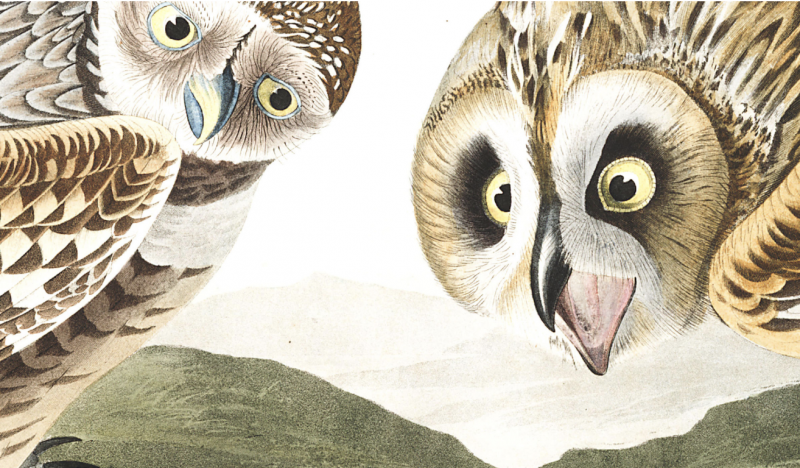
Bird lovers generally fall into two groups: meticulous cataloguers who record observable detail and observers who attribute anthropomorphic personalities and expressions to birds. Audubon's The Birds of America comprises 435 life-size watercolors produced between 1827 and 1838. The Audubon Society's redesigned website offers free high-resolution downloads of all 435 plates, MP3 recordings of each specimen's call, and vintage commentary that mixes scientific description with unintentionally humorous phrasing. Descriptive field notes capture behavioral specifics such as burrow maintenance, communal habitation, subterranean refuge when alarmed, and conspicuous defensive displays at burrow entrances. Historical ornithological notes vary from precise natural history to vivid, expressive portrayals.
"Our sus­pi­cions have lit­tle to do with biol­o­gy, but rather, a cer­tain zesti­ness of expres­sion, an overem­phat­ic beak, a droll gleam in the eye. The Audubon Society's new­ly redesigned web­site abounds with trea­sure for those in either camp: Free high res down­loads of all 435 plates. Mp3s of each specimen's call. And vin­tage com­men­tary that effec­tive­ly splits the dif­fer­ence between sci­ence and the unin­ten­tion­al­ly humor­ous locu­tions of anoth­er age."
"Take for instance, the Bur­row­ing Owl, as described by self-taught nat­u­ral­ist Thomas Say (1787-1834): It is delight­ful, dur­ing fine weath­er, to see these live­ly lit­tle crea­tures sport­ing about the entrance of their bur­rows, which are always kept in the neat­est repair, and are often inhab­it­ed by sev­er­al indi­vid­u­als. When alarmed, they imme­di­ate­ly take refuge in their sub­ter­ranean cham­bers; or, if the dread­ed dan­ger be not imme­di­ate­ly impend­ing, they stand near the brink of the entrance, brave­ly bark­ing and flour­ish­ing their tails, or else sit erect to recon­noitre the move­ments of the ene­my."
Read at Open Culture
Unable to calculate read time
Collection
[
|
...
]