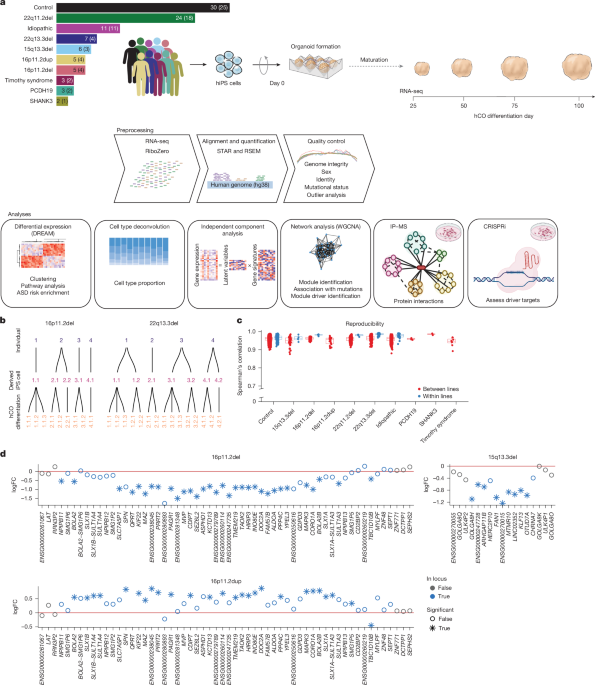
"Autism spectrum disorder (ASD) is a common neurodevelopmental disorder (NDD), with a childhood prevalence of close to 2%18. The last decade of genetic studies has yielded hundreds of risk genes, consistent with extraordinary aetiological heterogeneity1,2,3,4. More than 100 high-confidence mutations have been associated with ASD in genetic studies2,5,6,7,8,9,10,11,12,13. These rare, usually de novo mutations with large effect sizes are expected to account for 10-15% of ASD cases19,20, whereas common genetic variation is predicted to explain at least 50% of genetic risk."
"Despite its genetic heterogeneity, postmortem transcriptome analysis has revealed consistent changes in most individuals with idiopathic ASD, as well as individuals with a specific syndromic form of ASD, (dup)15q11-13 (refs. 14,15,16,17). However, the mechanisms by which distinct mutations can lead to convergent molecular pathology, and whether convergence occurs across rare forms of ASD remains unknown. Understanding how these processes develop is complicated by the fact that the expression of most ASD risk genes peaks during fetal development,"
Autism spectrum disorder affects close to 2% of children and exhibits extraordinary genetic heterogeneity with hundreds of risk genes identified. More than 100 high-confidence, usually de novo mutations with large effects account for 10–15% of cases, while common genetic variation explains at least 50% of genetic risk. ASD genetic architecture includes distinct rare disorders with overlapping clinical features. Postmortem transcriptome analyses reveal consistent molecular changes across idiopathic ASD and certain syndromic forms. Convergent molecular pathology may arise despite diverse mutations. Expression of most ASD risk genes peaks during fetal development, complicating postnatal brain studies. Stem cell-based in vitro systems enable modeling of human neurodevelopment and ASD-related mechanisms.
Read at Nature
Unable to calculate read time
Collection
[
|
...
]