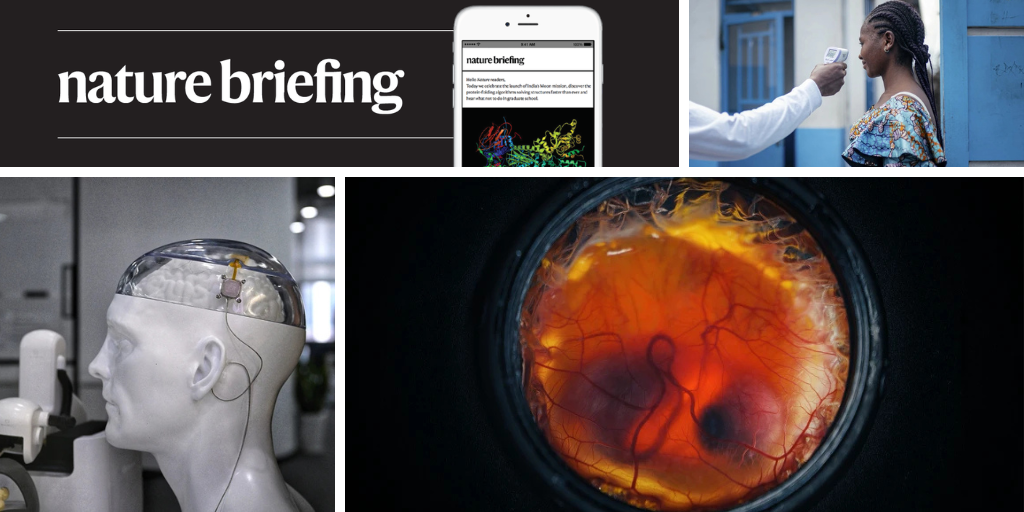
Start-up companies in China are developing artificial-intelligence-powered brain-computer interfaces to help people move, speak, and control external devices. NeuroXess has run a small trial in which a man with a spinal cord injury controlled appliances by moving a computer cursor with thoughts. The company has also developed a large language model intended to decode Mandarin from a brain implant faster than average native speaking speed. Scientists are racing to trial experimental treatments and potentially vaccines for the rare Bundibugyo species of Ebola spreading in the Democratic Republic of the Congo and Uganda. A World Health Organization-sponsored clinical trial is planned to test a broad-acting antiviral and a mixture of two antibodies, pending government approval. Health officials are also considering whether an approved vaccine for another Ebola species could be tested in the current outbreak. Colossal Biosciences reports progress toward de-extinction using an artificial egg, aiming to resurrect the South Island giant moa and rescue endangered birds.
"Start-up firms in China are ramping up their efforts to develop artificial-intelligence-powered brain-computer interfaces (BCIs) that can help people move, speak and control external devices. One company, NeuroXess, has run a small trial in which a BCI enabled one man with a spinal cord injury to control appliances by moving a computer cursor with his thoughts. The company has also developed a large language model that enables a brain implant to decode Mandarin at a rate faster than the average talking speed of a native speaker."
"Scientists are racing to trial experimental treatments and potentially vaccines against the rare Bundibugyo species of the Ebola virus, which is spreading in the Democratic Republic of the Congo and Uganda. A World Health Organization-sponsored clinical trial is set to test two treatments - a broad-acting antiviral and a mixture of two antibodies that recognizes diverse strains of Ebola - pending approval by the two countries' governments. Options for vaccines are limited, but health officials are considering whether an approved vaccine for another species of Ebola virus could be trialled in the current outbreak."
"The de-extinction company Colossal Biosciences says it has developed a key technology for bringing back extinct birds and rescuing endangered ones: an artificial egg. Colossal says it hopes to use the egg as part of its plan to resurrect the extinct South Island giant moa ( Dinornis robustus). The egg is detailed in a press release and video, but not in a paper or preprint."
#ai-brain-computer-interfaces #ebola-therapeutics #ebola-vaccines #clinical-trials #de-extinction-technology
Read at Nature
Unable to calculate read time
Collection
[
|
...
]