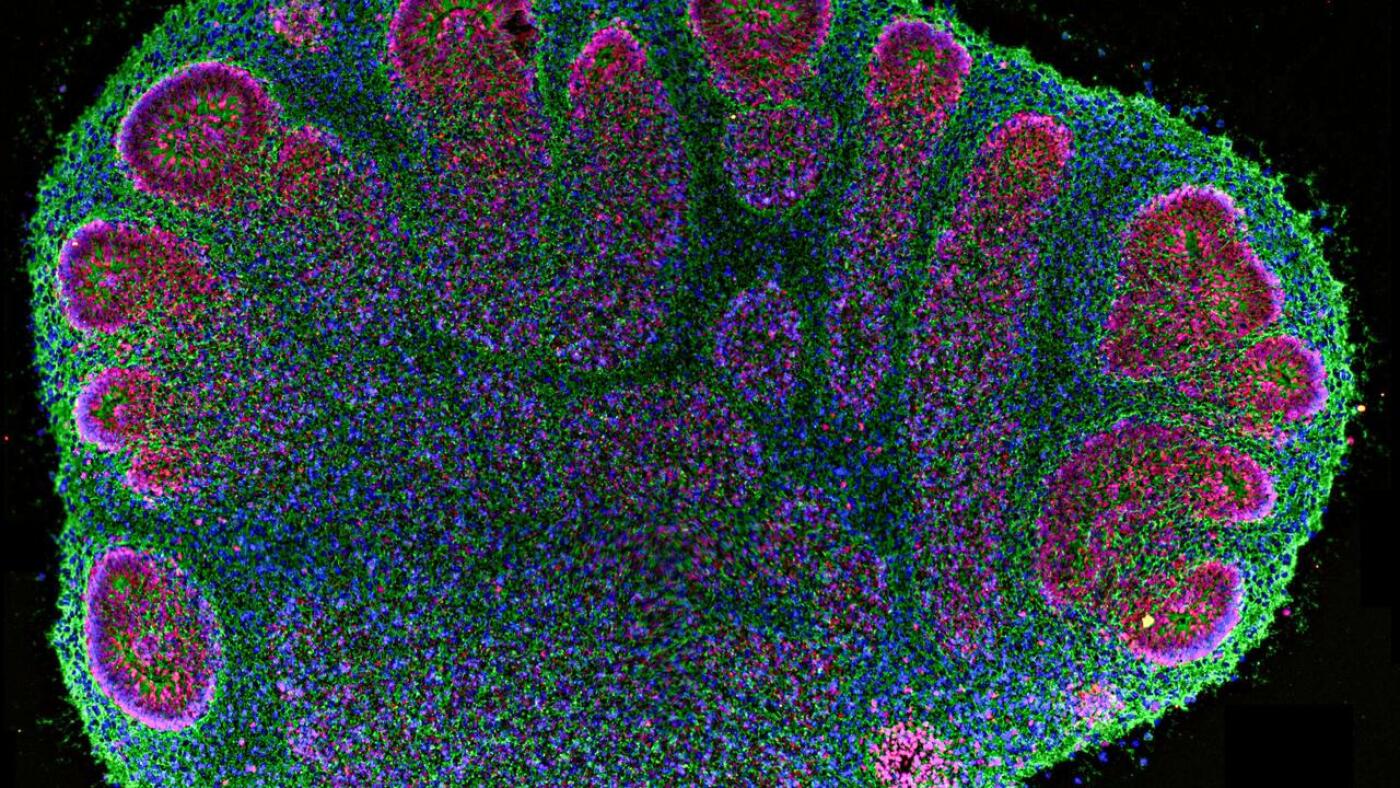
"Research on conditions like autism, schizophrenia and even brain cancer increasingly relies on clusters of human cells called brain organoids. These pea-size bits of neural tissue model aspects of human brain development as they grow for months and even years in a lab. They also make many people uneasy, in part because the brain is so closely tied to our sense of self."
"Among the questions: Is it okay to place human organoids in an animal's brain? Can organoids feel pain? Can they become conscious? Who, if anyone, should regulate this research? "We are talking about an organ that is at the seat of human consciousness. It's the seat of personality and who we are," says Insoo Hyun, a bioethicist at the Museum of Science, Boston, who attended the meeting. "So it's reasonable to be especially careful with the kind of experiments we're doing," he says."
"Organoids are allowing scientists to study brain cells and circuits that don't exist in animals, Pasca says. "For the first time, we have this ability to really work with human neurons and human glial cells," he says, "and ask questions about these really mysterious disorders of the brain." But Pasca's work has sometimes caused public unease as his lab has recreated a human pain pathway, and transplanted a human organoid into the brain of a rat."
Brain organoids are clusters of human cells that model aspects of human brain development and can grow for months or years in laboratory conditions. They enable study of disorders such as autism, schizophrenia and brain cancer by providing access to human neurons and glial cells and circuits absent in animals. Ethical questions include whether organoids can feel pain or achieve consciousness, whether implantation into animal brains is permissible, and what regulatory oversight is appropriate. Some labs have recreated human pain pathways and transplanted human organoids into rats, prompting public unease and calls for careful consideration by scientists, ethicists and other stakeholders.
Read at www.npr.org
Unable to calculate read time
Collection
[
|
...
]