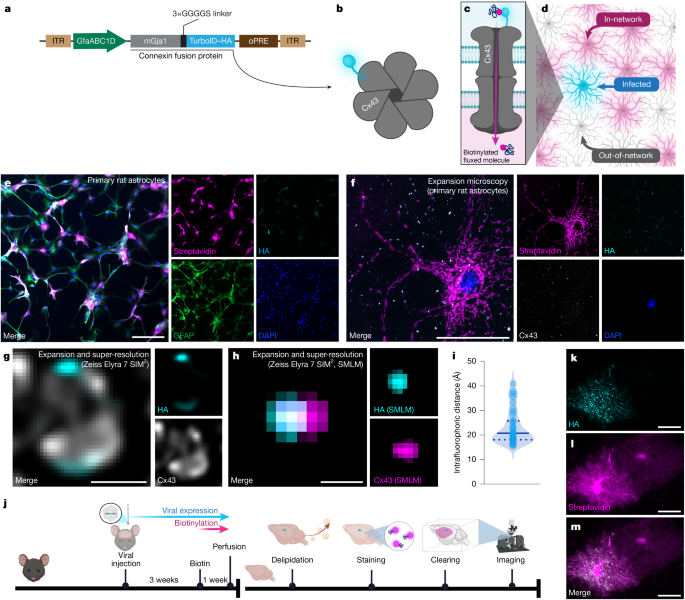
"Astrocyte intercellular communication is critical to proper CNS function. This communication occurs through gap junctions-membrane channels that connect the cytoplasm of neighbouring cells, enabling them to redistribute resources and share biochemical signals."
"Studies using mice lacking astrocyte gap junctions have shown that these gap junctions are necessary for memory formation, synaptic plasticity, coordination of neuronal signalling, and closing the visual and motor critical periods."
"Despite these insights, our understanding of the spatial architecture and functional topology of astrocyte networks remains limited. Existing methods are inherently constrained to local environments and often disrupt native connectivity."
"To address this knowledge gap, we developed a vector-based approach to express a fusion protein comprising connexin 43 and TurboID, enabling detection of the infected astrocyte population."
Astrocyte intercellular communication through gap junctions is vital for central nervous system (CNS) function. These junctions facilitate resource redistribution and biochemical signal sharing among neighboring cells. Research indicates that astrocyte gap junctions are crucial for memory formation, synaptic plasticity, and neuronal signaling coordination. In pathological conditions, astrocyte networks help protect degenerating neurons by redistributing metabolic resources. However, the spatial architecture and functional topology of astrocyte networks are not well understood, necessitating new methods to trace these networks and their connectivity with neuronal systems.
Read at Nature
Unable to calculate read time
Collection
[
|
...
]