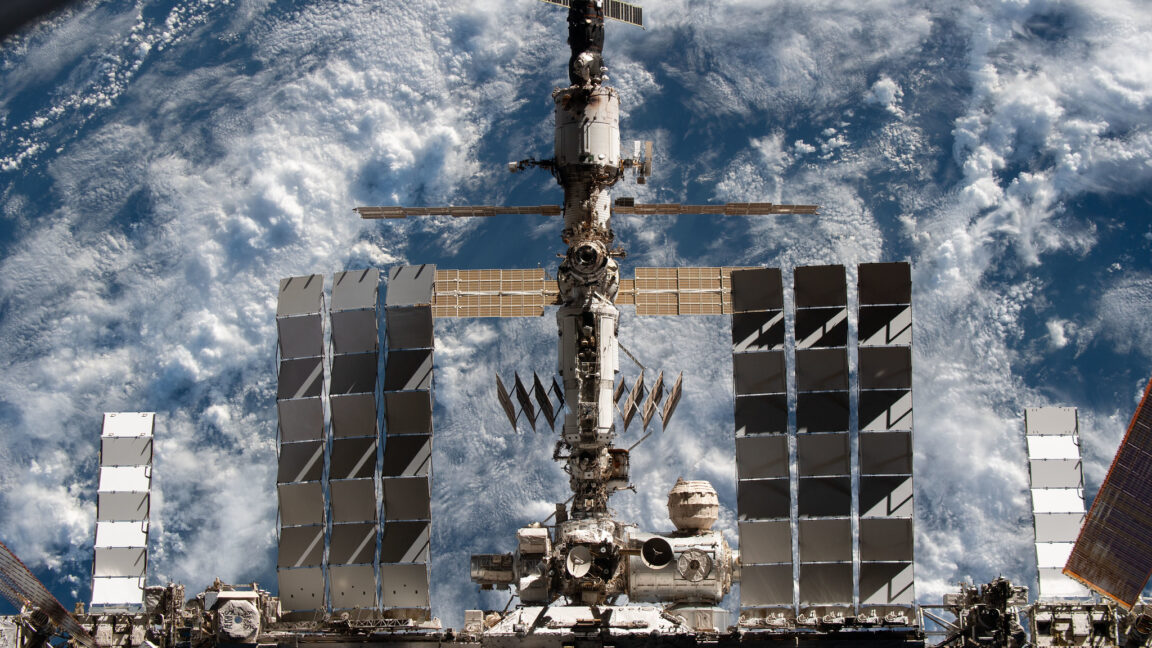
Microscopic structural cracks inside the small PrK transfer tunnel on the Russian segment of the International Space Station caused persistent atmospheric leaks for years. The PrK lies between a Progress spacecraft airlock and the Zvezda Service Module. Leak rates doubled in 2024, prompting classification as a high-likelihood, high-consequence risk. After repeated inspections and sealing activities, including application of a patented Germetall-1 sealant, pressure in the PrK is now holding steady. Russian cosmonauts repeatedly closed the hatch, checked for dust accumulation to locate leaks, applied sealant, monitored pressure, and repeated the process. Monitoring by NASA and Roscosmos continues.
""Following additional inspections and sealing activities, the pressure in the transfer tunnel attached to the Zvezda Service Module of the International Space Station, known as the PrK, is holding steady in a stable configuration," a space agency spokesman, Josh Finch, told Ars. "NASA and Roscosmos continue to monitor and investigate the previously observed cracks for any future changes that may occur.""
"They would periodically close the hatch leading to the PrK module and then, upon re-opening it, look for tiny accumulations of dust to indicate the leak sites. Then the Russian cosmonauts would apply a sealant known as Germetall-1 (which has now been patented) to the cracks. They would close the hatch again, monitor the pressure inside the PrK module, and begin the search anew for additional leaks."
Read at Ars Technica
Unable to calculate read time
Collection
[
|
...
]