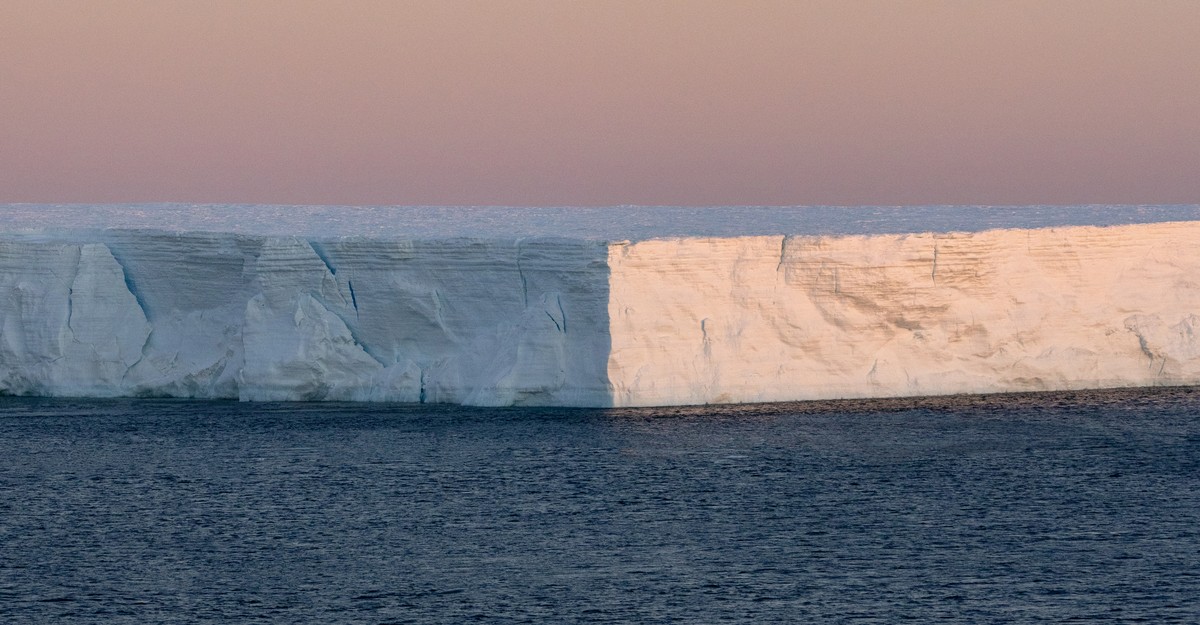
An international team is installing sensors on and around Thwaites Glacier to collect measurements near the grounding line and on a nearby moraine. A fiber-optic cable will be lowered through a 3,200-foot borehole in the ice, and another cable will be deployed from the South Korean icebreaker RV Araon for a robot to traverse daily to a rocky moraine in the Amundsen Sea. The sensors will record data over the next two years to fill gaps in knowledge about ocean currents and temperatures that erode the glacier from below. Models using these measurements will test whether a giant seabed curtain could divert warm water and slow or prevent collapse.
"On Thwaites itself, part of the team will try today to drop a fiber-optic cable through a 3,200-foot borehole in the ice, near the glacier's grounding line, where the ocean is eating away at it from below. Sometime in the next week, another part of the team, working from the South Korean icebreaker RV Araon, aims to drop another cable, which a robot will traverse once a day, down to a rocky moraine in the Amundsen Sea."
"To avert catastrophe in this way would be a massive undertaking: The curtain itself would need to be up to 500 feet tall and 50 miles long. But these local conditions are in such tentative balance-"on a knife's edge," David Holland, a climate scientist at NYU and a member of the Seabed Curtain Project, told me from the deck of the RV Araon-that Holland and some other scientists believe that an intervention could change the glacier's fate."
Read at The Atlantic
Unable to calculate read time
Collection
[
|
...
]