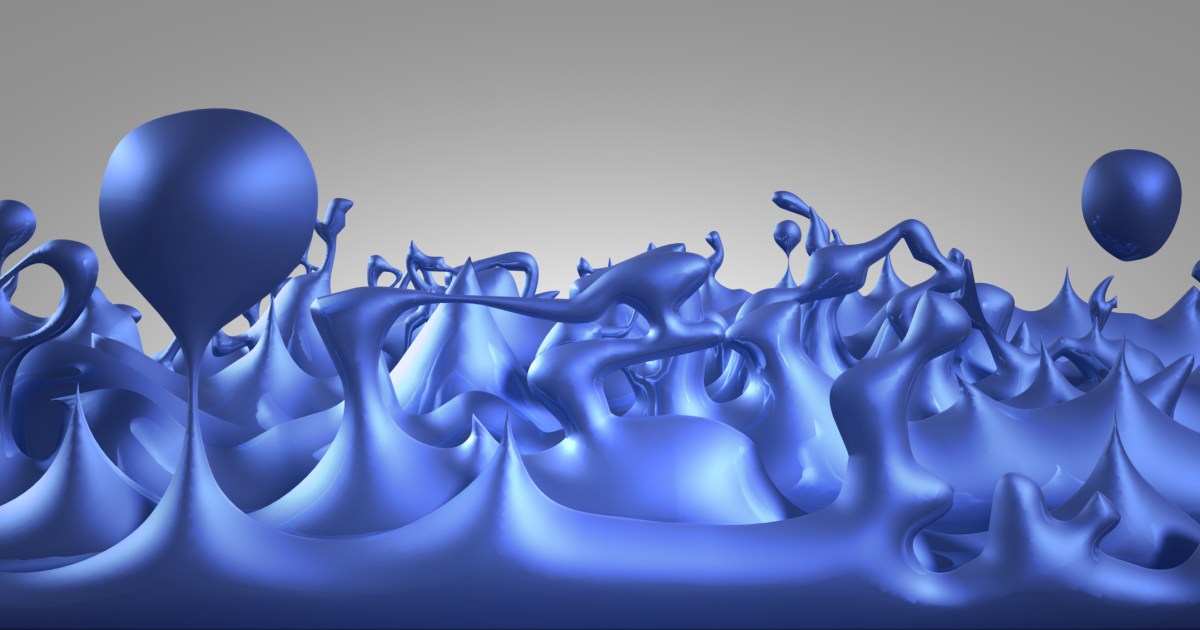
"For centuries, the laws of physics seemed completely deterministic. If you knew where every particle was, how fast it was moving, and what the forces were between them at any one instant, you could know exactly where they'd be and what they'd be doing at any point in the future. From Newton to Maxwell, the rules that governed the Universe had no built-in, inherent uncertainty to them in any form. Your only limits arose from your limited knowledge, measurements, and calculational power."
"All of that changed a little over 100 years ago. From radioactivity to the photoelectric effect to the behavior of light when you passed it through a double slit, we began realizing that under many circumstances, we could only predict the probability that various outcomes would arise as a consequence of the quantum nature of our Universe. But along with this new, counterintuitive picture of reality, many myths and misconceptions have arisen."
"When we think of quantum effects, we typically think about individual particles (or waves) and the bizarre properties they display. But large-scale, macroscopic effects happen that are inherently quantum in nature. Conducting metals cooled below a certain temperature become superconductors: where their resistance drops to zero. Building superconducting tracks where magnets levitate above them and travel around them without ever slowing down is a routine student science project these days, built on an inherently quantum effect."
Classical physics presented a deterministic view: complete knowledge of particle positions, velocities, and forces predicted the future exactly. Quantum physics introduced fundamental probabilistic outcomes in phenomena like radioactivity, the photoelectric effect, and double-slit interference. Many misconceptions emerged about quantum behavior. Quantum effects can manifest on macroscopic scales, producing superconductivity, where resistance drops to zero, magnetic levitation over superconducting tracks, superfluids, and quantum drums that exhibit simultaneous vibrational states. Several Nobel Prizes have recognized macroscopic quantum phenomena. The notion that quantum always means strictly discrete is an important concept but does not fully encompass quantum behavior.
Read at Big Think
Unable to calculate read time
Collection
[
|
...
]