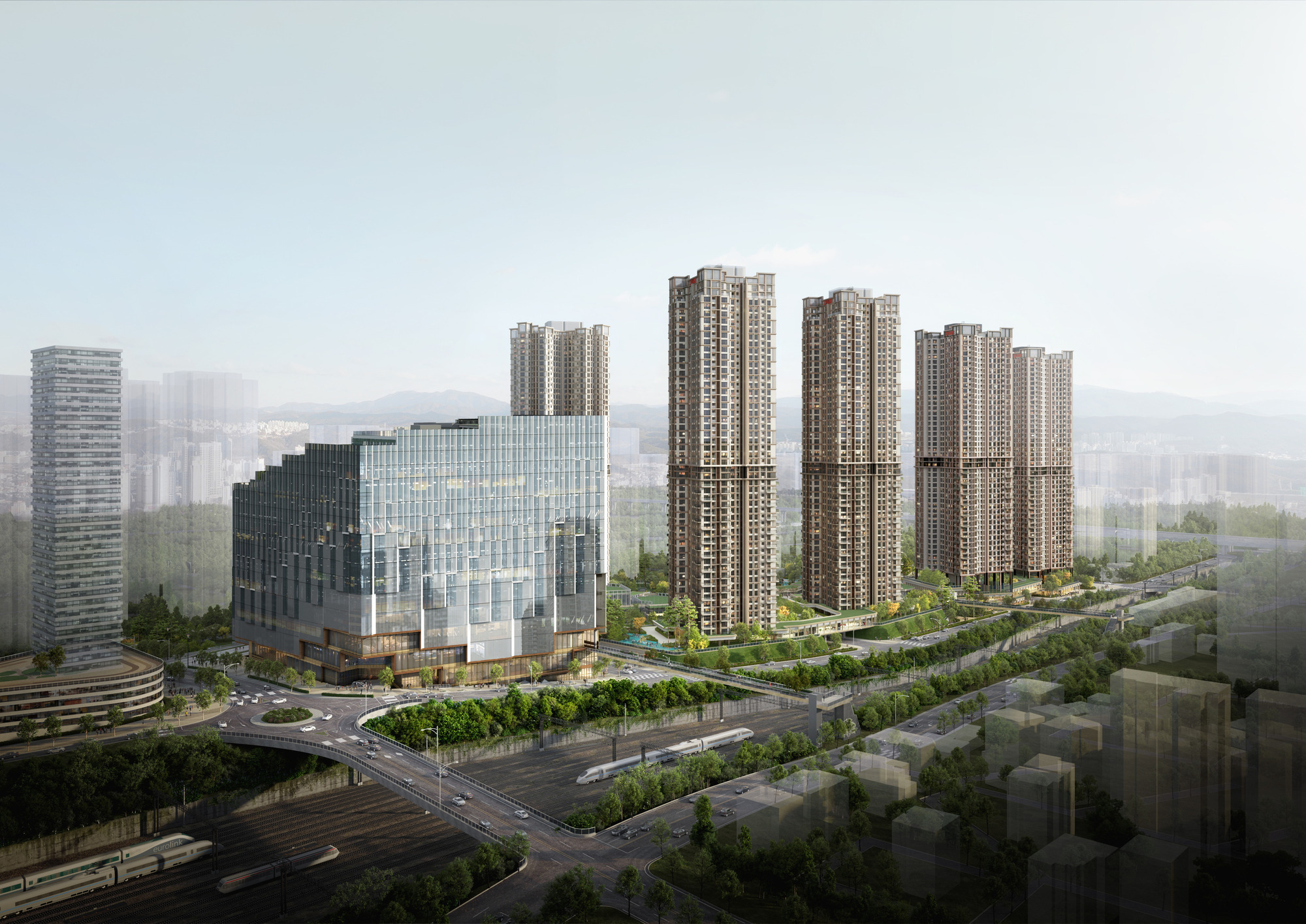
SeoulOne is a 405,000 m² car-free mixed-use neighborhood in northeast Seoul designed for multigenerational living. Residential towers, retail, offices, a hotel, sports facilities, daycare centers, senior living and a medical center provide permanent services within a 10-minute walk. More than 30% of the site is dedicated to vegetation, including pocket parks, roof gardens, water gardens and a forest walk, creating a year-round green village. The design follows traditional Korean urban planning principles, aligning building forms with nearby mountainous topography and maintaining continuous green space. Pedestrian bridges connect surrounding neighborhoods. The scheme integrates green and blue networks, clean energy, smart technologies and locally sourced materials to reduce waste and carbon footprint. The master plan is structured around six layers that collectively express the development’s organisational framework.
"UNS has revealed images of SeoulOne, a master plan designed for Hyundai Development Company (HDC) in Seoul, South Korea, intended as a new model for multigenerational living. The project, already under construction on a brownfield site in the northeast of the city, reimagines an existing industrial site and railway area as a 405,000 m² car-free neighborhood for a multigenerational community."
"The concept for SeoulOne is also guided by traditional Korean urban planning principles, which typically respond to surrounding natural landscapes. The site, located close to the city's mountainous northeast, sets the stage for the project's conceptual and organizational design language. The continuity of green space is to be maintained throughout the development, while the buildings' forms follow the topography of the nearby mountains and create visual corridors toward them."
"Keeping the master plan car-free extends this respect for nature and led to the introduction of pedestrian bridges connecting to surrounding neighborhoods. According to UNS, SeoulOne integrates green and blue networks, clean energy systems, and smart city technologies to reduce its environmental impact. Locally sourced materials, including those inspired by traditional Korean ceramics, were used to minimize waste and lower the project's carbon footprint."
Read at ArchDaily
Unable to calculate read time
Collection
[
|
...
]