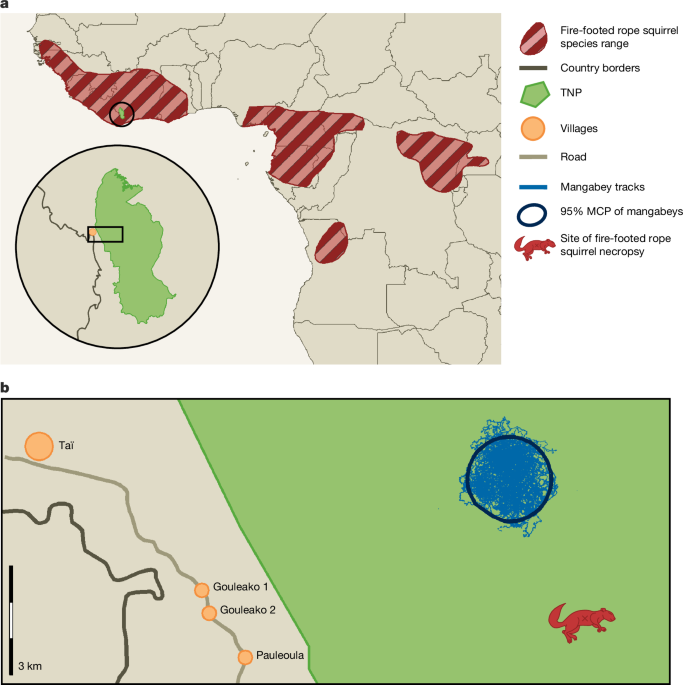
"The recent emergence of MPXV lineages characterized by human-to-human transmission through sexual networks has led the World Health Organization (WHO) to declare public health emergencies of international concern in 2022 (ref. 1) and 2024 (ref. 2). Efforts were immediately scaled up in endemic African countries to reinforce mpox surveillance systems. Concurrently, sustained human-to-human transmission was shown to leave a distinct signature in MPXV genomes identifiable as APOBEC3-induced mutations, providing a tool to determine how much MPXV evolution happened in humans12."
"Building on these advances, recent genomic surveillance data from the Democratic Republic of Congo (DRC), the Republic of Congo, Nigeria and Cameroon clearly showed that MPXV diversity mostly reflects numerous, independent zoonotic spillovers13,14,15. Importantly, epidemiological data from the DRC suggest that these spillovers increased in frequency from 2010 to 2024, a period during which the national surveillance system has been relatively stable3."
"Identifying the animal(s) that serve as reservoir(s) for MPXV may help in managing the risk of spillover to humans and preventing subsequent outbreaks fuelled by human-to-human transmission. Following others16, we define a reservoir as a natural host in which the virus can circulate permanently and from which transmission to another host-humans in the case of zoonoses-is possible and documented. According to this definition, no MPXV reservoir has yet been identified."
WHO declared public health emergencies in 2022 and 2024 after MPXV lineages spread via human-to-human sexual networks. Genomic surveillance showed that sustained human transmission leaves APOBEC3-induced mutation signatures, enabling detection of human-adapted evolution. Recent data from DRC, Republic of Congo, Nigeria and Cameroon indicate MPXV diversity largely results from numerous independent zoonotic spillovers, with spillover frequency increasing in the DRC between 2010 and 2024 despite stable surveillance. No confirmed natural reservoir has been identified. Rodents, including Thomas's rope squirrel sampled in 1985, remain leading candidate hosts. Identifying reservoirs would aid spillover risk management and outbreak prevention.
Read at Nature
Unable to calculate read time
Collection
[
|
...
]