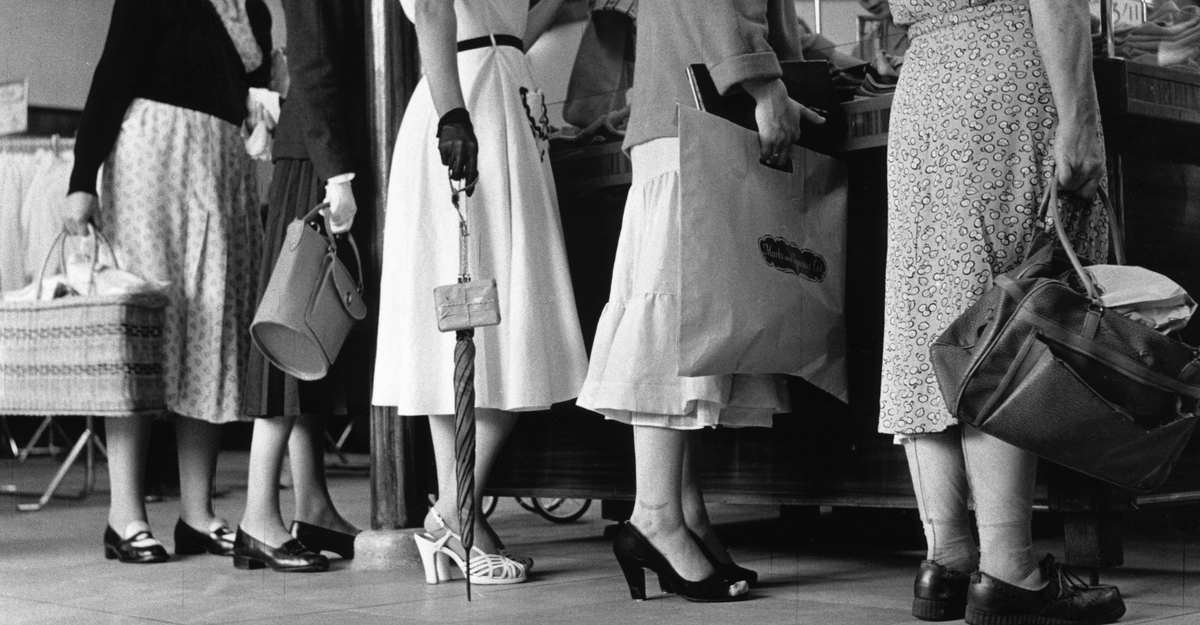
"A recent grocery run in Brooklyn left me properly confused. When I approached the registers, little coconut waters in hand, two options presented themselves: I could get in the self-checkout line, in which dozens of headphone-wearing customers thumbed through their phones. Or I could go through the staffed checkout lane, which had no wait at all. What a bunch of schmucks! I thought. I breezed through the cashier's lane and was soon out the door, while many of my fellow shoppers remained in self-checkout, languishing."
"One thing I thought I knew about Americans was that unless we're waiting for something that really hypes us up-a hotly anticipated concert, the chance to buy TikTok's artifact du jour-we don't exactly love queuing. Whole business ventures have emerged to limit people's time spent waiting. Meanwhile, standing in line at a grocery store or the DMV is often characterized as a universally reviled bummer. In a 1984 Time essay, one writer lamented that "waiting is a form of imprisonment," an "interval of nonbeing.""
"Apparently, though, many grocery stores across the country regularly see longer lines for self-checkout than for cashiers. A friend of mine recently told me that the line for self-checkout at her Manhattan Whole Foods tends to snake around the store; sometimes, employees encourage people to move to the shorter, regular line-yet still only a handful will defect. Posters on Reddit have witnessed this behavior in Albany, Memphis, and Ajax, Canada. Steve Caine, a Chicago-based consultant at Bain & Company who focuses partly on the grocery sector, told me he's noticed it at his Costco too."
Many shoppers opt for self-checkout even when staffed cashier lanes are shorter or empty. Observations in Brooklyn, Manhattan, Albany, Memphis, Ajax, and at Costco report self-checkout lines snaking while cashier lanes stay short. Data from NPS Prism by Bain & Company show self-checkout adoption has steadily increased across age groups and in both urban and suburban areas. Businesses have emerged to reduce waiting time, reflecting a broader cultural aversion to queues. Historical commentary frames waiting as imprisonment, implying complex motivations—such as perceived control, privacy, novelty, or habit—behind choosing longer self-checkout lines.
Read at The Atlantic
Unable to calculate read time
Collection
[
|
...
]