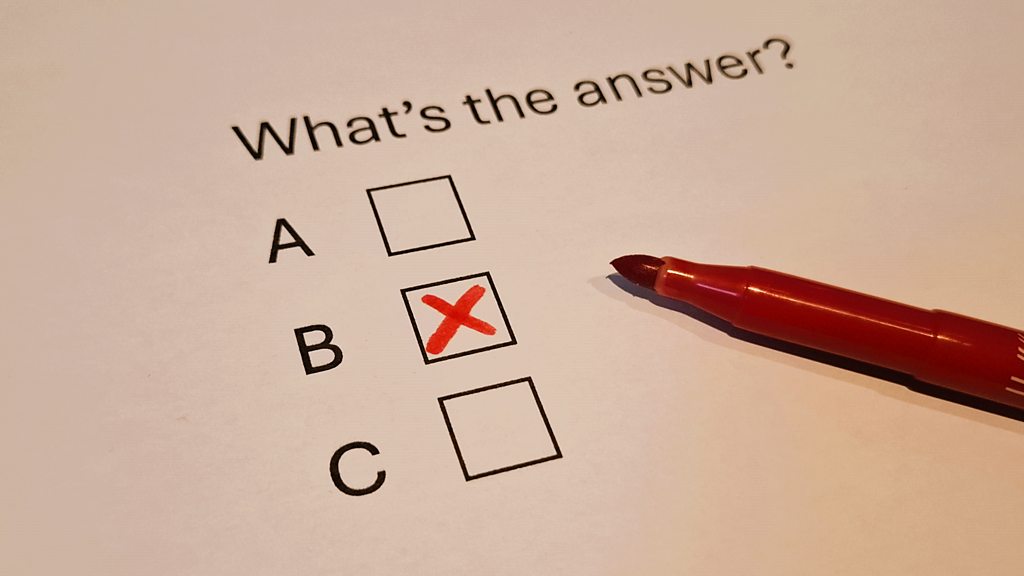
"His question leads presenter Alex Lathbridge on a journey into the murky depths of our brain, where he discovers the cognitive biases which so often trip us up in games of chance, or probability. Your brain might be a marvellous machine when it comes to figuring out how to understand the world, but sometimes, in the name of efficiency, it takes clever little short-cuts to the answer."
"With the help of mathematician Kit Yates from the University of Bath in the UK, and some rather stale sweets, Alex will be finding out how to win at games of chance. Alex also explores the world of gaming, and gambling. Games of chance in which our intuition sometimes lets us down, and makes us choose unwisely. Rachel Croson, Professor of Economics at the University of Minnesota, USA, talks us through how the human brain can work against us."
A listener noticed that multiple-choice answers on a quiz are almost never 'a' and usually 'b' or 'c', prompting an investigation into why. Alex Lathbridge explores cognitive biases that lead the brain to take efficient shortcuts which can produce incorrect judgments in mathematics, chance, and probability. Mathematician Kit Yates uses stale sweets to demonstrate strategies for winning at games of chance. The episode examines gaming and gambling where intuition fails, with Rachel Croson explaining how the brain can work against decision-making and Maria Konnikova describing applying psychology to succeed at poker.
Read at BBC
Unable to calculate read time
Collection
[
|
...
]