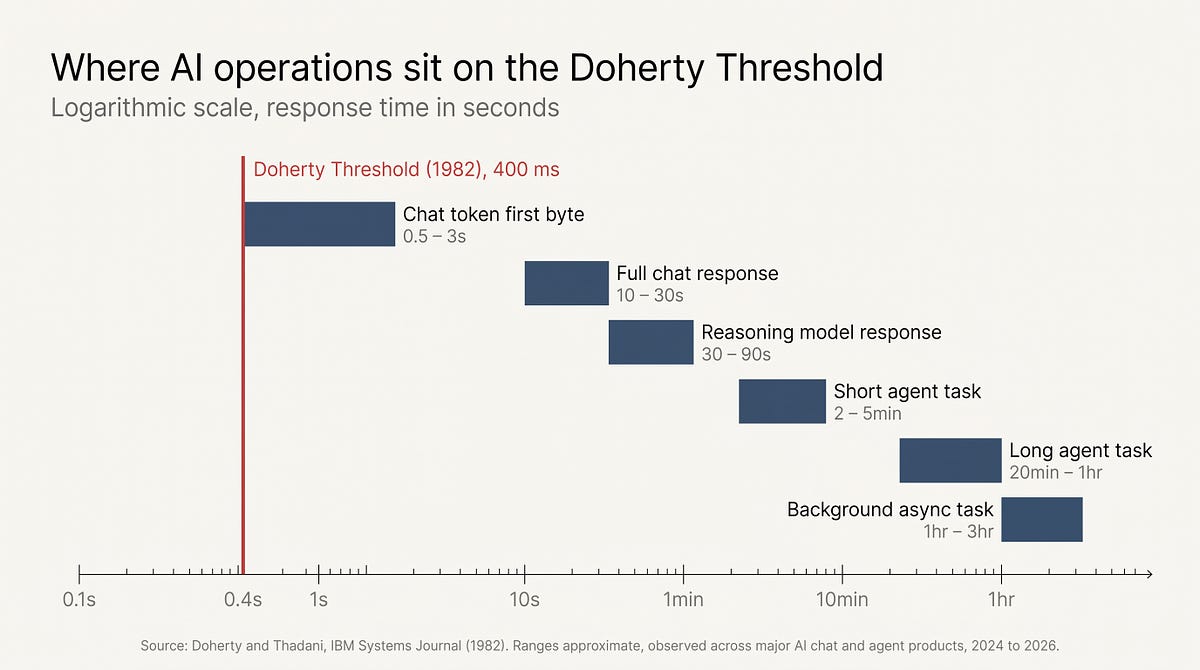
A known human-computer response-time limit around 400 milliseconds keeps users in a productive loop. When response time exceeds that threshold, attention leaks away from the task. When delays reach around ten seconds, attention typically leaves the screen entirely. Observed user behavior shows people start an AI query, wait briefly, switch tabs, then return and repeat the same question because they do not realize the first answer finished. Major AI products released in 2023 and 2024 fail to meet the threshold, and newer agent systems still miss it by minutes. The underlying issue is waiting time that prevents users from staying engaged and thinking with the system.
"She typed a question into an AI chat, hit enter, and the spinner appeared. She switched tabs. Forty-three seconds later she came back, scrolled up, scrolled down, and typed the same question again. She had no idea the first answer had already finished. This is the waiting problem."
"We have known the productive number for human-computer response time since 1982. Walter J. Doherty's IBM Systems Journal paper, summarized in Laws of UX as the Doherty Threshold, put it at roughly 400 milliseconds. Below the threshold, users stay in a productive loop with the system. Above it, attention leaks. Above ten seconds, attention typically leaves the screen entirely."
"Every major AI product launched in 2023 and 2024 missed that threshold. The agent generation that shipped in 2025 and 2026 missed it by minutes."
"The Doherty Threshold has been a published, citable, named number in HCI for over forty years. The original IBM paper measured user productivity at terminals and found that response times under approximately 400 milliseconds produced not an incremental gain but a different mode of work. Users stopped waiting for the machine and started thinking with it."
Read at Medium
Unable to calculate read time
Collection
[
|
...
]