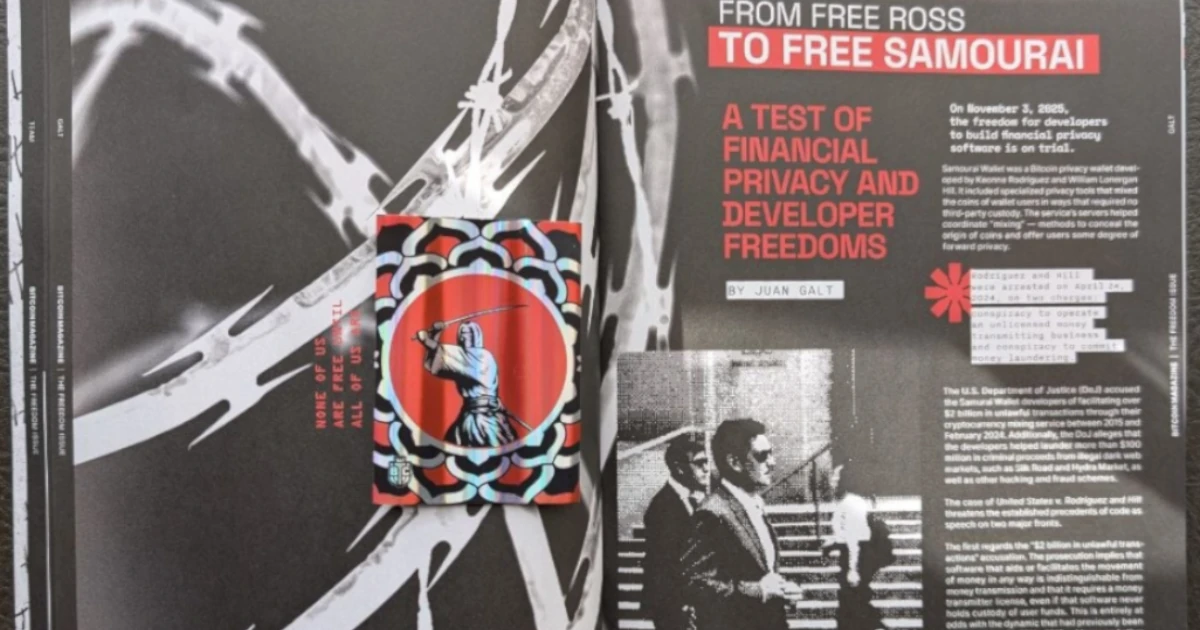
"On November 3, 2025, the freedom for developers to build financial privacy software is on trial. Samourai Wallet was a Bitcoin privacy wallet developed by Keonne Rodriguez and William Lonergan Hill. It included specialized privacy tools that mixed the coins of wallet users in ways that required no third-party custody. The service's servers helped coordinate "mixing" - methods to conceal the origin of coins and offer users some degree of forward privacy."
"Rodriguez and Hill were arrested on April 24, 2024, on two charges: conspiracy to operate an unlicensed money transmitting business and conspiracy to commit money laundering. The U.S. Department of Justice (DoJ) accused the Samurai Wallet developers of facilitating over $2 billion in unlawful transactions through their cryptocurrency mixing service between 2015 and February 2024. Additionally, the DoJ alleges that the developers helped launder more than $100 million in criminal proceeds from illegal dark web markets, such as Silk Road and Hydra Market."
"The first regards the "$2 billion in unlawful transactions" accusation. The prosecution implies that software that aids or facilitates the movement of money in any way is indistinguishable from money transmission and that it requires a money transmitter license, even if that software never holds custody of user funds. This is entirely at odds with the dynamic that had previously been established by FinCEN's 2019 guidance and other legacy financial regulations."
Samourai Wallet provided non-custodial Bitcoin privacy tools that coordinated coin mixing to conceal transaction origins and offer forward privacy. Developers Keonne Rodriguez and William Lonergan Hill were arrested on April 24, 2024, and charged with operating an unlicensed money transmitting business and conspiracy to commit money laundering. The U.S. Department of Justice alleges the service facilitated over $2 billion in unlawful transactions and laundered more than $100 million from dark‑web markets like Silk Road and Hydra Market. The prosecution treats facilitating value movement via software as equivalent to money transmission requiring licensing, and the case raises questions about constitutional protections for privacy‑defending software.
Read at Bitcoin Magazine
Unable to calculate read time
Collection
[
|
...
]