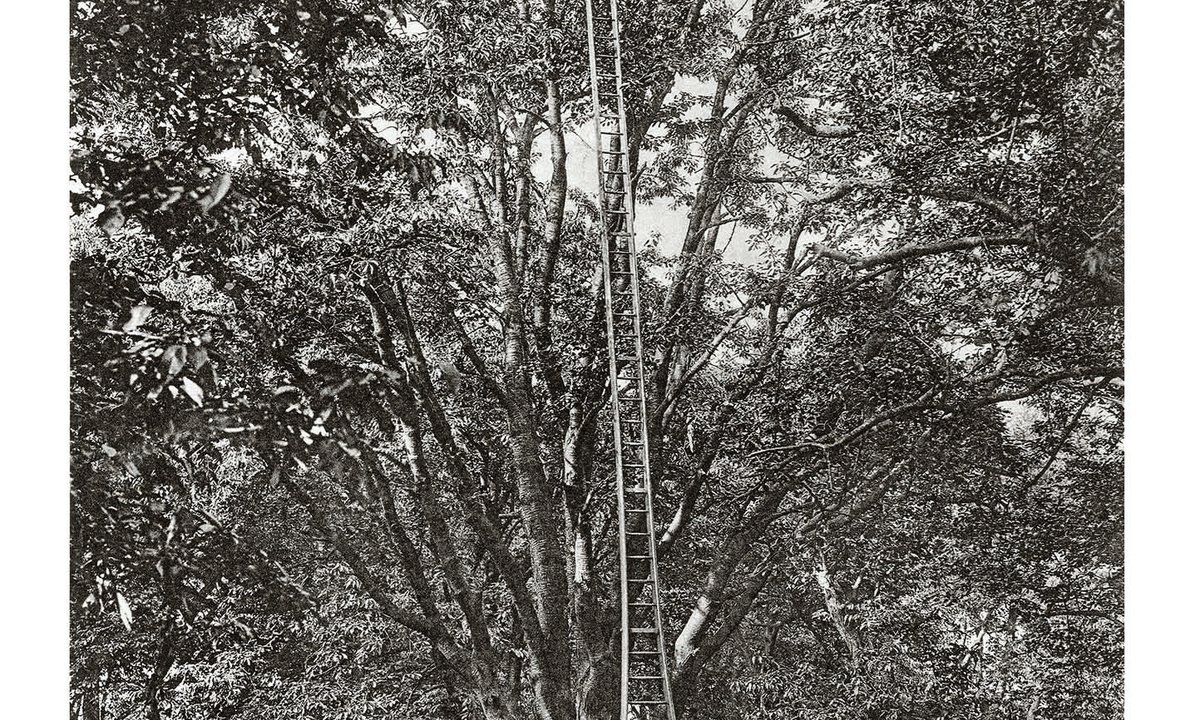
Photographs taken between 1906 and 1913 were originally produced for Henry John Elwes and Augustine Henry’s The Trees of Great Britain and Ireland. The project aimed to provide a complete account of trees growing naturally or cultivated in each country, resulting in seven volumes and 2,022 pages. More than 400 photographs, mostly by uncredited photographers, accompanied precise botanical descriptions of over 500 species. The work aligned with an era focused on cataloguing and classifying nature and reflected photography’s growing role in creating visual records for science. The images were printed by the Autotype Company using a collotype process that produced varied tonal range and a restrained, poetic softness, with newly lithoprinted reproductions preserving detailed gradients.
"The photographs in this volume, taken between 1906 and 1913, were originally produced for Henry John Elwes and Augustine Henry's The Trees of Great Britain and Ireland, an ambitious photographic catalogue designed, Elwes wrote, to "give a complete account of all the trees which grow naturally or are cultivated" in each country. Filling seven volumes and 2,022 pages, the series boasted more than 400 photographs-mostly taken by uncredited photographers-appearing alongside exacting botanical descriptions of over 500 species."
"Elwes and Henry's project, conceived initially as a sequel to John Claudius Loudon's Arboretum et Fruticetum Britannicum (1835-38), "was consistent with the prevailing ethos of the period to catalogue and classify", writes Michael Pritchard, former chief executive of the Royal Photographic Society, in an introduction to this new selected edition. The project also encapsulated the increasingly widespread use of photography as "a means to create a visual record to support science and new ways of classifying the natural world"."
"In the early 1900s, these photographs were printed by the Autotype Company using a high-quality collotype process capable of producing a varied tonal range, lending the photographs "a restrained and almost poetic softness", writes the photographic historian Björn Andersson in his accompanying notes. Newly lithoprinted to honour the collotype gradients, the photographs here remain lusciously detailed, the colliding shapes and"
#botanical-photography #british-and-irish-trees #scientific-cataloguing #collotype-printing #natural-history
Read at The Art Newspaper - International art news and events
Unable to calculate read time
Collection
[
|
...
]