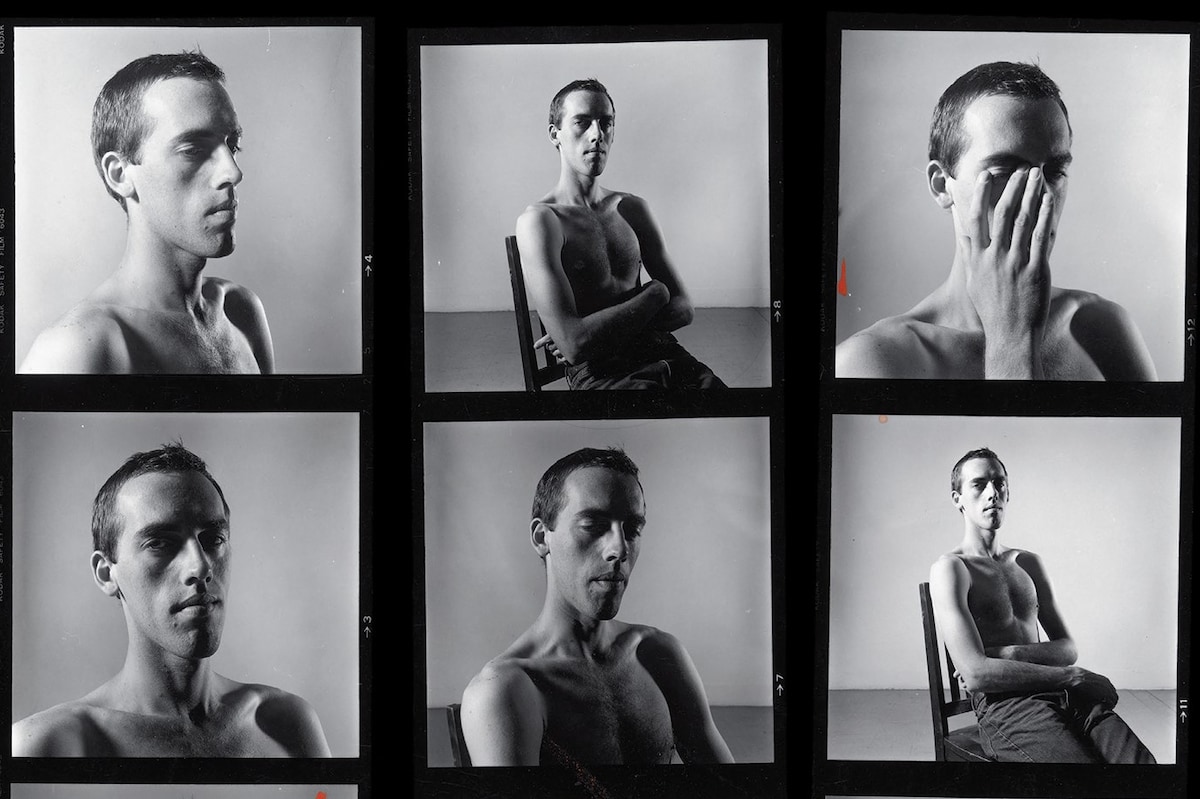
Contact sheets are stored as thousands of individually sleeved, sorted photographic records from Peter Hujar’s life. They are functional and visually unremarkable, yet contain a complete world of images and process. A contact sheet is made by placing strips of negative film onto photosensitive paper and exposing them to light, producing a single print that shows multiple frames from a roll. As photography moved from plates to film rolls, contact sheets became a tool for selecting negatives to enlarge. They act as an index of what occurred before the camera and a preview of potential prints, capturing the creative process between exposure and editing, thinking, and printing.
"“Today's audience for photography, and tomorrow's, doesn't necessarily understand the relevance of the contact sheet,” contends Smith. “There is no comparable object in the regime of digital photographic practice.” McCall agrees there is simply “nothing that supersedes the intimacy of the contact sheets themselves”."
"A contact sheet is created by placing strips of negative film directly onto photosensitive paper. The negatives are exposed to light to produce a print that allows multiple exposures from a roll of film to be viewed at once. As photography shifted in the early 20th century from individual plates to film rolls, contact sheets became an intermediate tool for selecting which negatives to enlarge."
"Smith describes them as a kind of net that “traps the creative process of the artist between the exposure phase and the editing, thinking and printing”. The celluloid thumbnails offer both an indexical summary of what has passed before the camera's lens and a preview of the printed photographs."
Read at AnOther
Unable to calculate read time
Collection
[
|
...
]