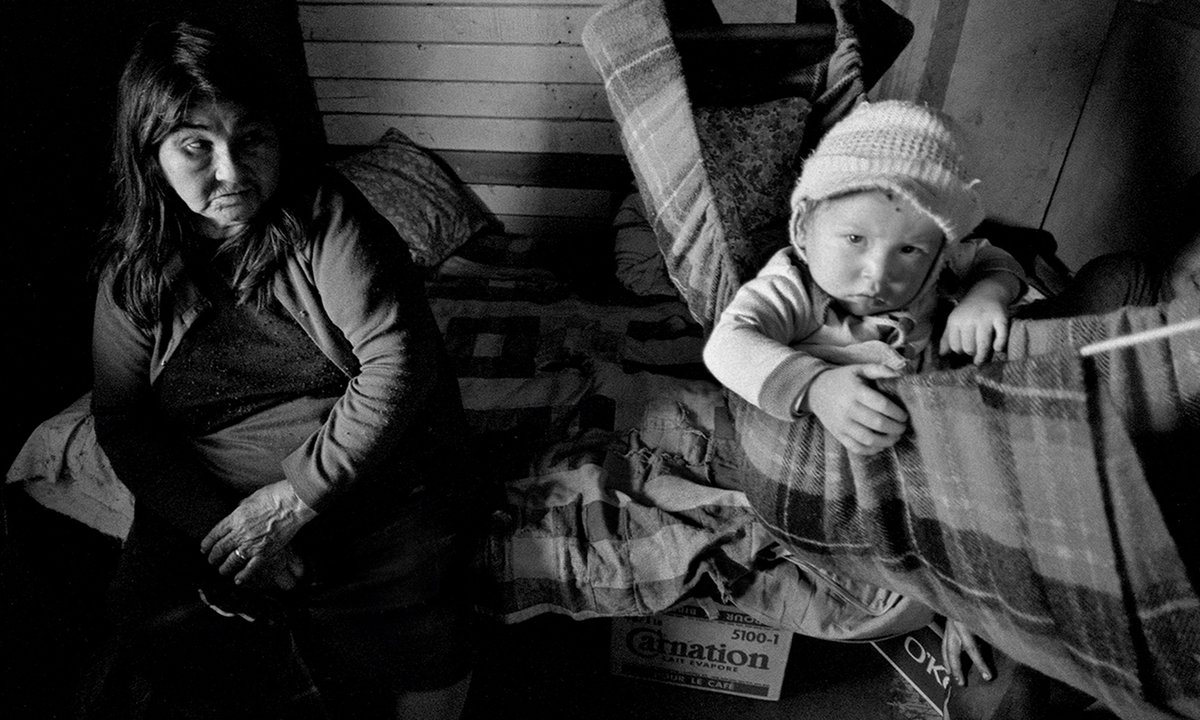
""I never expected to become a photographer when a friend put a Rolleiflex camera in my hands," writes Susan Ressler (born 1949 in Philadelphia) of her introduction to photography in 1968. Coming of age during an era of "tumultuous" political and social change, from the "pervasive unrest and idealism" of 1960s counterculture to the mounting violence of the Vietnam War,"
"Ressler accepted an invitation from the anthropologist Asen Balikci to document Algonquian communities in rural Quebec. "The experience was so profound that not only did it convince me to pursue photography to this day," she writes, "but the pictures I made then remained hidden for 35 years." Ressler expresses regret at her youthful naivety, unaware of "the complexities of documentary photography", a medium that risks exploiting subjects for the sake of one-sided or biased stories."
Susan Ressler, born 1949 in Philadelphia, began photography in 1968 after a friend placed a Rolleiflex camera in her hands. Ressler spent five decades documenting stark disparities of power and social inequality across the United States, portraying the coexistence of wealth and marginalization. Major projects include 1970s corporate boardroom studies in Los Angeles, intimate portraits of Algonquian and other First Nations families in Canada, and long-term examinations of Southern California's sprawling, hyper-real environments. Early Algonquian photographs taken in 1972 remained unpublished for 35 years. Ressler acknowledges ethical complexities and risks of exploitation in documentary photography.
Read at The Art Newspaper - International art news and events
Unable to calculate read time
Collection
[
|
...
]