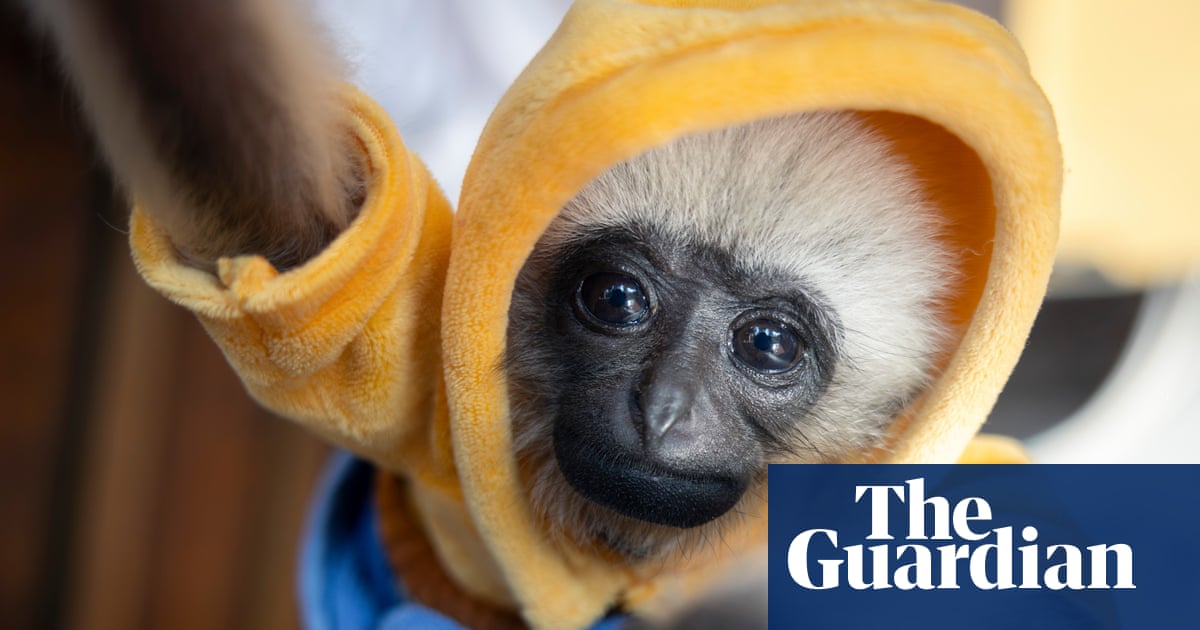
A wildlife officer at Omkoi wildlife sanctuary cares for Chokdee, a lar gibbon found alone in a village as a newborn. Dense white fur covers most of his body, with exposed face and palms. The gibbon likely escaped captivity, but capture probably followed the death of his mother. Gibbons are small arboreal apes native to south-east Asian rainforests and are among the world’s most threatened primate families. The IUCN lists one species as vulnerable, while the rest are endangered, with five critically endangered. Habitat loss and poaching for illegal exotic pet trade drive the decline. Traffic analysis shows trafficked gibbons seized by authorities reached an all-time high in 2025, with Thailand heavily affected. Poachers target infants because they are easier to capture, smuggle, and domesticate, and about 70% of traded gibbons are under two years old.
"We call him Chokdee, the officer says. It means good luck'. Chokdee is a lar gibbon (Hylobates lar), and in some ways he is lucky. He was a newborn when local people contacted wildlife services, saying they had found him alone in their village. I believe someone removed this gibbon from its original habitat, says Karin Hirankailas, who heads the sanctuary. Chokdee somehow escaped his captors, but for him to have been captured in the first place, his mother was probably killed."
"Gibbons small arboreal apes native to the rainforests of south-east Asia are one of the world's most threatened primate families, according to the International Union for Conservation of Nature (IUCN). One of the 20 species is classified as vulnerable on the IUCN red list, while all of the rest are endangered and at risk of extinction, and five are critically endangered. Alongside habitat loss, the main threat to gibbon populations is poaching for the illegal trade in exotic pets, for which there is growing demand."
"Analysis by the conservation organisation Traffic shows that the number of trafficked gibbons seized by authorities reached an all-time high in 2025, with Thailand among the most affected countries. Poachers tend to target infants, which are seen as being cuter but are also easier to capture, smuggle and domesticate. About 70% of gibbons in the trade are under two years old, says Susan Cheyne, vice-chair of the IUCN's small apes section."
Read at www.theguardian.com
Unable to calculate read time
Collection
[
|
...
]