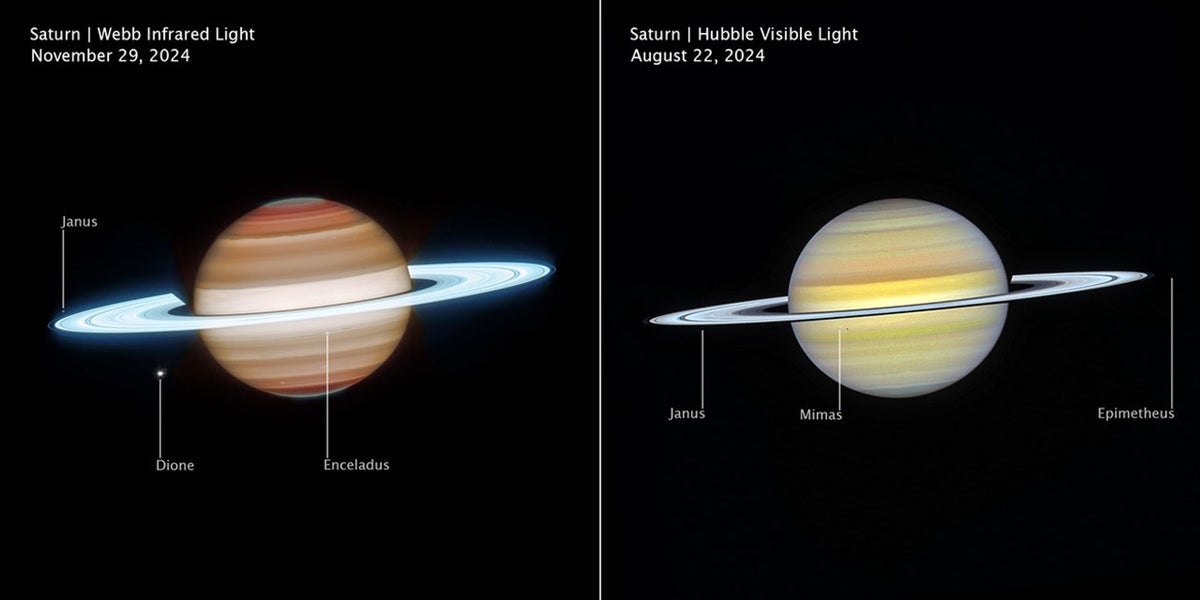
"Hubble captured the planet's reflected visible light and highlighted Saturn's iconic yellow hues, which are, in part, a product of the sunlight-reflecting ammonia crystals and hydrocarbons such as methane in its atmosphere."
"JWST, meanwhile, looked at the planet's infrared light to peer deeper into the layers of its atmosphere, allowing scientists to effectively slice through Saturn's atmosphere at multiple altitudes, like peeling back the layers of an onion."
Recent images from NASA's James Webb Space Telescope and Hubble Space Telescope showcase Saturn in both visible and infrared light. Hubble's images highlight Saturn's yellow hues due to ammonia crystals and hydrocarbons, while JWST's infrared observations allow deeper insights into the planet's atmospheric layers. The combination of data from both telescopes enhances understanding of Saturn's turbulent atmosphere, offering a detailed perspective that was previously unattainable. Together, they reveal different aspects of the planet's characteristics and composition.
Read at www.scientificamerican.com
Unable to calculate read time
Collection
[
|
...
]