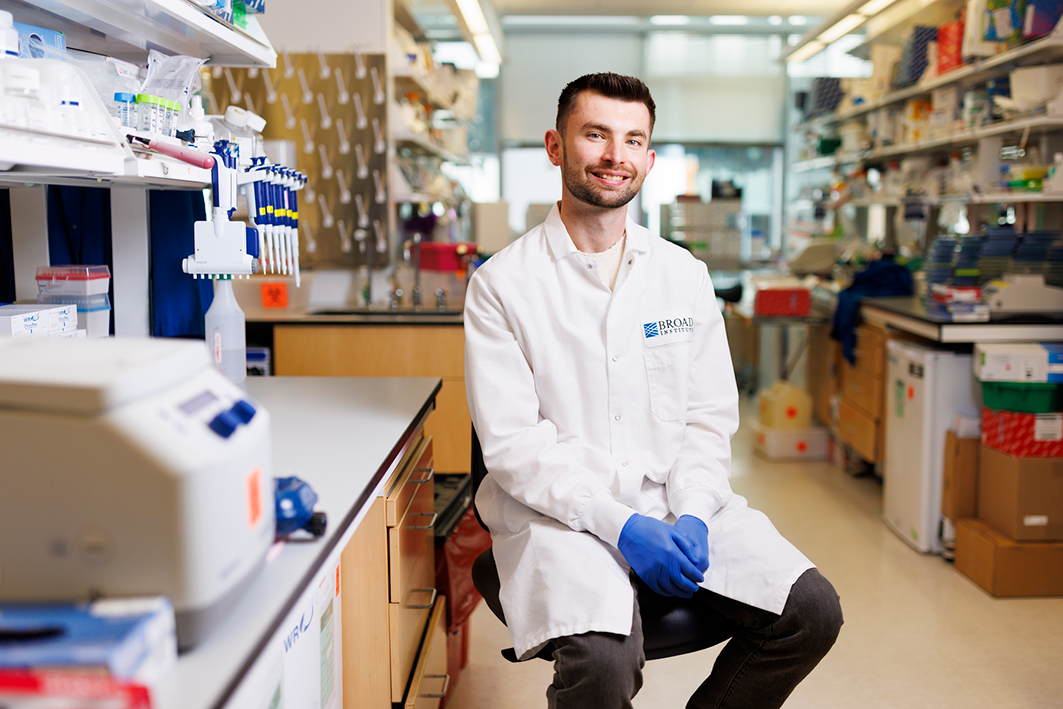
DNA replication captured Isaac Witte’s interest through the coordinated action of proteins and molecules that sustain life. He was drawn to the Meselson-Stahl experiment showing semiconservative DNA replication by tracking heavy and light nitrogen isotopes in E. coli. After starting at the University of California, Berkeley, he pursued a fellowship at the Stowers Institute, where he learned RNA interference by depleting genes and observing effects on regeneration in flatworms. Manipulating genetic pathways could produce organisms with altered head or tail structures. His interest in RNA interference led him to Jennifer Doudna’s lab, focusing on the naturally occurring mechanisms underlying CRISPR rather than only its human applications.
"It was DNA replication that first captured Isaac Witte's scientific imagination as a high school student in Overland Park, Kansas. "It's this orchestration of so many different proteins and molecules that come together to do this core element of life," he said. It always stuck with him how evolution could generate such a complex system that works - and that our cells run all the time."
"It wasn't just the discovery that intrigued Witte - who this month will receive his Ph.D. in biological and biomedical sciences from Harvard Griffin GSAS - but the experiment behind it, "the most beautiful experiment in biology." By growing generations of E. coli with a heavy isotope of nitrogen and then allowing the bacteria to divide in a solution with a lighter isotope, Matthew Meselson and Franklin Stahl found that the new DNA was of an intermediate weight, proving Watson and Crick's semiconservative replication hypothesis."
"In the summer after his first year at the University of California, Berkeley, Witte began a research fellowship at Kansas City's Stowers Institute for Medical Research, where he learned about RNA interference - depleting certain genes in a cell and seeing how the changes affected regeneration. Depending on the genetic pathway he manipulated in flatworms, they could end up with a couple of heads or tails."
"His interest in RNA interference led Witte to the lab of like-minded Jennifer Doudna when he returned for his sophomore year, a few years before Doudna received a Nobel Prize for her developments in CRISPR technology. Though Witte was interested in the gene-editing tool's promise for humans, he was more interested in studying the naturally occurring mechanism behind it."
Read at Harvard Gazette
Unable to calculate read time
Collection
[
|
...
]