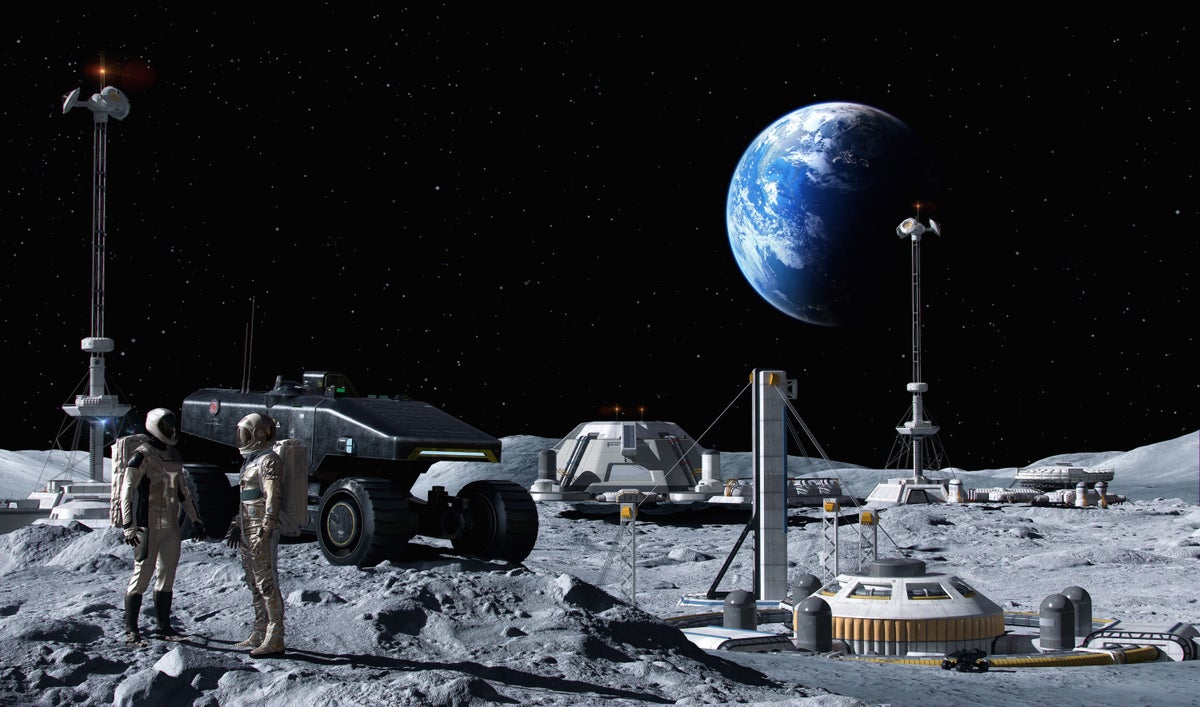
"Helium-3 is spectacularly useful, and demand for it is soaring. A superlative coolant, helium-3 enables quantum computers to reach their operating temperatures, fractions of a degree above absolute zero. The precious substance is also vital for advanced medical imaging, as well as sniffing out smuggled nuclear material, and holds promise as a clean fuel for future fusion reactors."
"On terra firma, most of the available supply of helium-3 comes as a by-product of nuclear weaponry via the radioactive decay of tritium, a rare isotope of hydrogen that boosts the power of thermonuclear bombs. This process makes just a few kilograms of helium-3 per year worldwide, and a single kilogram currently costs about $20 million."
"But scientists estimate that somewhere on the order of a billion kilograms of helium-3 are lacquered onto the lunar surface. So the moon-based mining of helium-3 could, it seems, someday become a multitrillion-dollar industry."
"All this sets helium-3 apart from another much ballyhooed lunar resource: water ice, found in some of the moon's deepest, darkest craters. Those reservoirs could hydrate crops and astronauts alike on any crewed moon base, and water split into"
Helium-3 is extremely valuable for multiple advanced applications, including cooling quantum computers to near-absolute-zero temperatures, supporting advanced medical imaging, detecting smuggled nuclear material, and serving as a promising clean fuel for future fusion reactors. Earth’s supply is limited because most available helium-3 is produced as a by-product of nuclear weapon-related tritium decay, yielding only a few kilograms per year worldwide. The current price is about $20 million per kilogram. Scientists estimate roughly a billion kilograms of helium-3 may be present on the lunar surface, suggesting lunar mining could become a multitrillion-dollar industry. This potential is contrasted with lunar water ice, which could support life support and fuel production for moon bases.
Read at www.scientificamerican.com
Unable to calculate read time
Collection
[
|
...
]