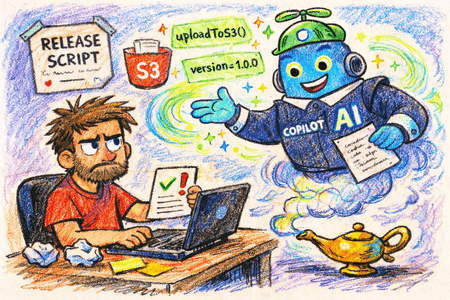
"Just recently I wanted to write a script that uploads a directory to S3. I decided to use Copilot. I have been using it for a while. This article is an attempt to prove two things: (a) that AI can't (still) replace me as a senior software engineer and (b) that it still makes sense to learn programming and focus on the fundamentals. Let's dig in."
"I want from you to create a folder called "script" and write a script in there that will upload files to AWS. The script will be used from this package as a dependency. Meaning that I'll probably do "node path-to-package/scripts/release.js". Make sure that the script is asking for a new version and updates the package.json file in the root folder of the project."
"At each step I'll make a mark of the underlying knowledge that I apply to evaluate the output and guide the next steps. I hope that this will be useful for you to understand that AI is not a magic wand that can replace software engineers, but rather a tool. If all this seems obvious to you, then great. But you should know that there are many people out there that don't have a clue about those details"
A developer attempted to use Copilot to create a script that uploads a directory to S3 and manages releases. The initial prompt requested a 'script' folder with release.js that uploads files to AWS, can be invoked as a package dependency, prompts for a new semantic version, updates package.json in the project root, and requests a CHANGELOG entry to update the project's CHANGELOG file. The developer recorded the knowledge used to evaluate Copilot output, including CLI script concepts, semantic versioning, and changelog importance. Copilot generated a script folder and release.js that prompts for a version and changelog and appears to upload files.
Read at krasimirtsonev.com
Unable to calculate read time
Collection
[
|
...
]