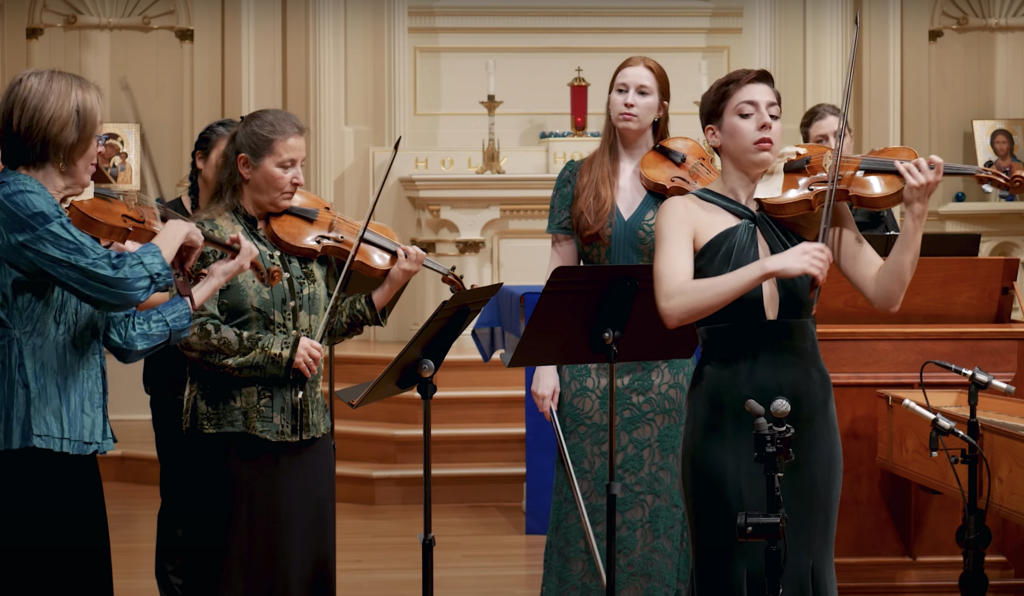
"Upon its debut in 1725, The Four Sea­sons stunned lis­ten­ers by telling a sto­ry with­out the help of a human voice. Vival­di drew on four exist­ing son­nets (pos­si­bly of his own prove­nance), using strings to paint a nar­ra­tive filled with spring thun­der­storms, summer's swel­ter, autum­nal hunts and har­vests, and the icy winds of win­ter. The com­pos­er stud­ded his score with pre­cise­ly placed lines from the son­nets, to con­vey his expec­ta­tions that the musi­cians would use their instru­ments to son­i­cal­ly embody the expe­ri­ences being described."
"The last hun­dred years, how­ev­er, have seen a wide range of instru­ments and inter­pre­ta­tions. Drums, synths, an elec­tric gui­tar, a Chi­nese pipa, an Indi­an saran­gi, a pair of Inu­it throat singers, a Japan­ese a cap­pel­la women's cho­rus, a Theremin and a musi­cal saw are among those to have tak­en a stab at The Four Sea­sons ' drows­ing goatherd, bark­ing dog, and twit­ter­ing birdies."
Vivaldi's The Four Seasons is an early 18th-century work that vividly depicts seasonal scenes through instrumental music. The composition premiered in 1725 and relied on four sonnets, possibly by Vivaldi, to shape its narrative. Precise sonnet lines were placed in the score to guide musicians in evoking thunder, heat, hunts, harvests, and winter winds. For two centuries performers followed Vivaldi's original orchestration closely. During the past hundred years performers have experimented with a wide array of instruments and styles. Revisiting the original orchestration offers an authentic alternative; the San Francisco ensemble Voices of Music presents such performances in a live playlist.
Read at Open Culture
Unable to calculate read time
Collection
[
|
...
]