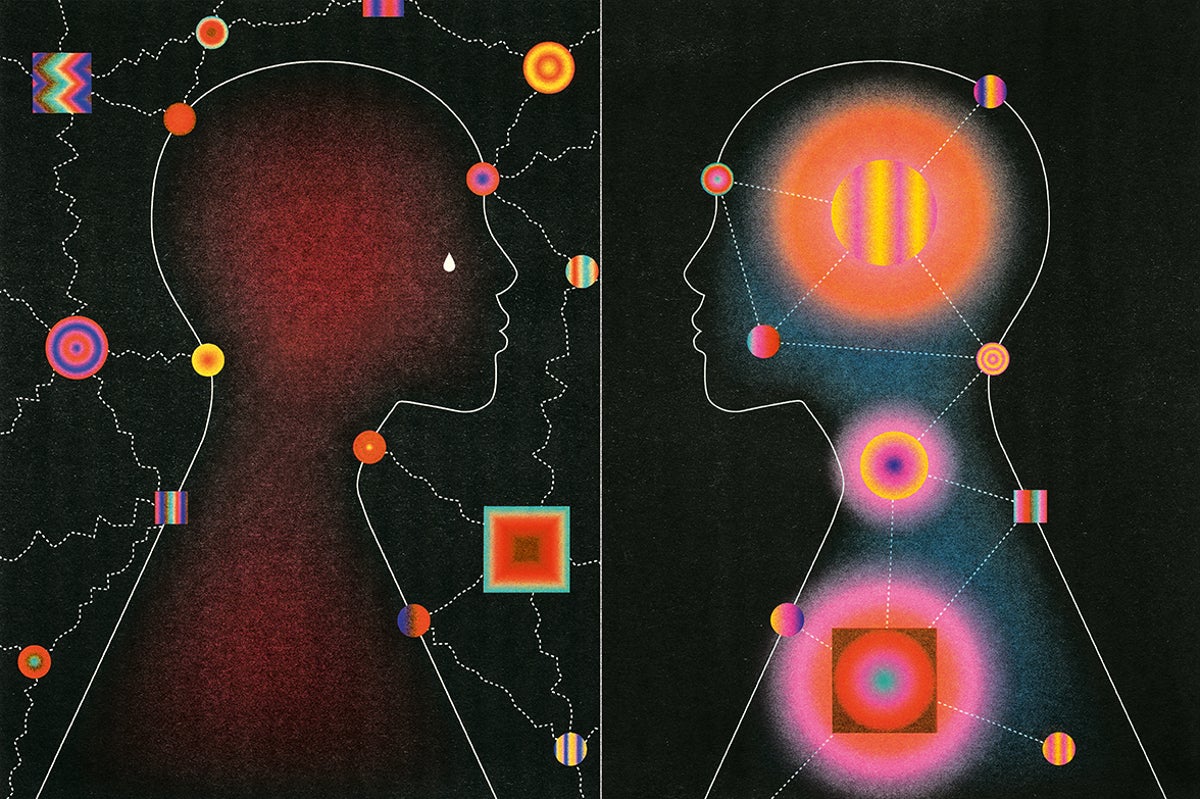
"So when May heard about a trial of a new and unconventional therapy, she jumped at the opportunity. The treatment was unusual in that alongside talk therapy, May underwent several sessions in a sensory-deprivation chamber: a dark, soundproof room where she floated in a shallow pool of water heated to match the temperature of her skin and saturated with Epsom salts to make her more buoyant."
"The goal was to blunt May's external senses, enabling her to feel from withinfocusing on the steady thudding of her heart, the gentle flow of air in and out of her lungs, and other internal bodily signals. The ability to connect with the body's inner signals is called interoception. Some people are better at it than others, and one's aptitude for it may change. Life events can also bolster or damage a person's interoceptive skills. Sahib Khalsa, a psychiatrist and neuroscientist at the University"
Maggie May, an Arkansas resident in her 30s, experienced years of atypical anorexia nervosa with severe food restriction and distorted body image despite psychotherapy and dietitian interventions. She entered a trial combining talk therapy with flotation-REST sensory-deprivation sessions in a dark, soundproof chamber where she floated in skin-temperature, Epsom-salt–saturated water to blunt external senses and amplify internal bodily signals. Interoception refers to sensing internal bodily states and varies across individuals and life events. Sahib Khalsa and colleagues hypothesized that disrupted interoception leads to underreliance on internal cues and overreliance on external appearance cues, contributing to distorted body image, and launched a trial in 2018.
Read at www.scientificamerican.com
Unable to calculate read time
Collection
[
|
...
]