"Ageing has a profound effect on the immune system, including the T cell repertoire, leading to reduced immune resilience. Central to this decline in humans and most other mammals is the involution of the thymus. Thymic involution curtails naive T cell output, contracts T cell receptor (TCR) repertoire diversity and blunts primary responses, whereas peripheral T cells accrue dysfunctional states that heighten susceptibility to infection, vaccine failure and cancer."
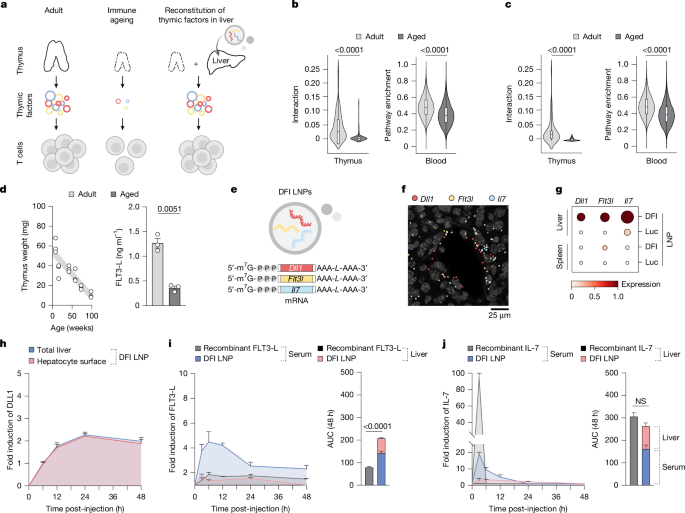
"Here we describe an approach for reconstituting thymus-derived factors in the liver to address age-related immune decline (Fig. 1a). We first identified signalling pathways in the thymus and peripheral blood T cells that decline with age. We then delivered mRNAs encoding these factors (DLL1, FLT3-L and IL-7) to the liver using lipid nanoparticles (LNPs). We found that this approach significantly improved immune response in ageing mice in both vaccination and cancer immunotherapy models"
Ageing reduces thymic output and shrinks T cell receptor diversity, diminishing primary immune responses and lowering overall immune resilience. Thymic involution and peripheral T cell dysfunction increase susceptibility to infection, vaccine failure and cancer. Previous interventions targeted thymic involution with hormones, cytokines, small molecules, heterochronic parabiosis or haematopoiesis modulation but faced limited efficacy, toxicity or feasibility. Delivering mRNAs for DLL1, FLT3-L and IL-7 to the liver using lipid nanoparticles reconstitutes thymus-derived trophic cues. Hepatic expression of these factors improves vaccination and cancer immunotherapy responses in ageing mice without observed adverse effects or increased autoimmunity.
Read at Nature
Unable to calculate read time
Collection
[
|
...
]