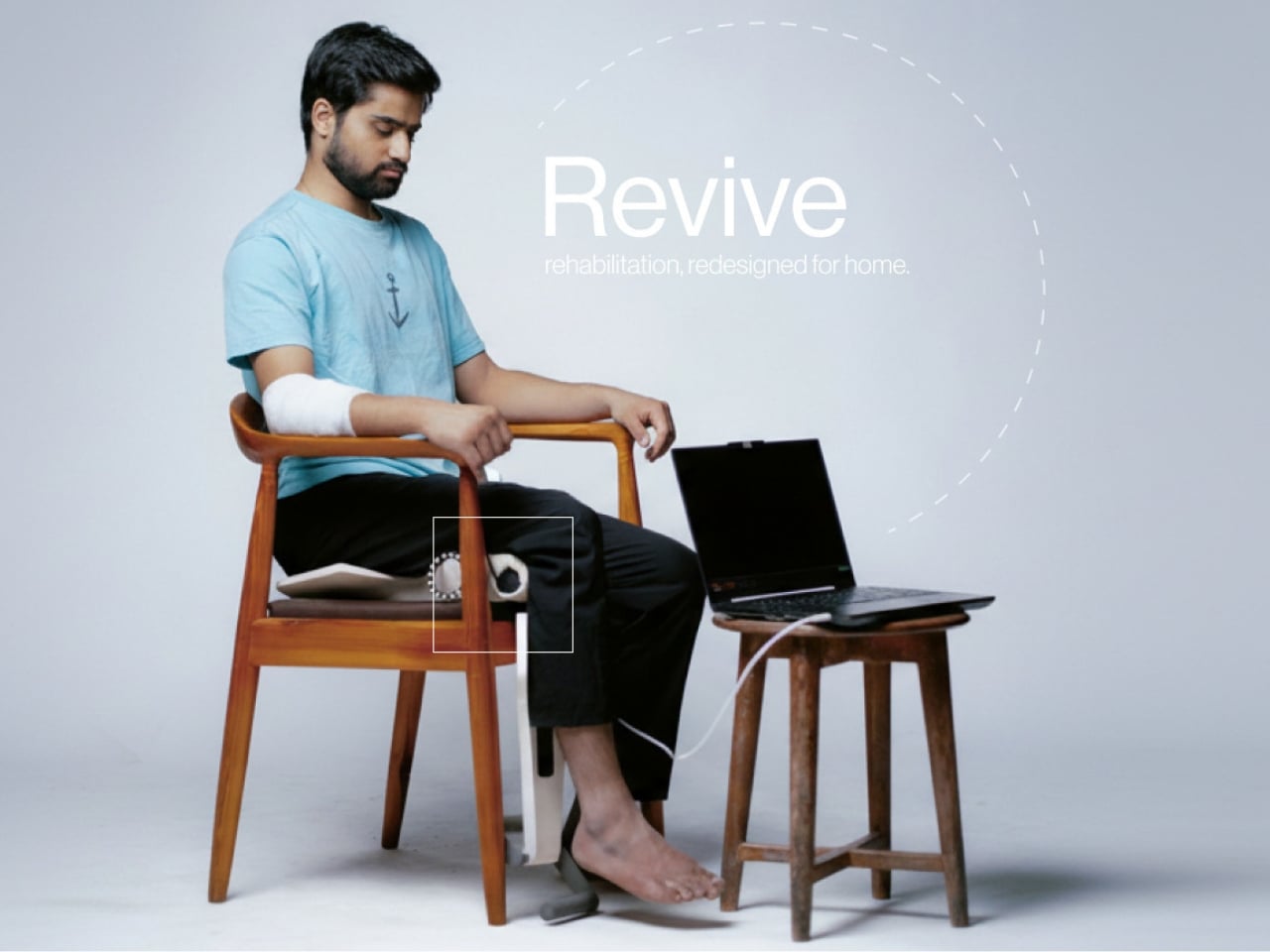
"There's something quietly radical about designing for pain. Not the dramatic, cinematic kind, but the daily grind of chronic discomfort that shapes how millions of people move through their lives. That's exactly what Madhav Binu, Kriti V, and Himvall Sindhu set out to tackle with Revive, a home-based rehabilitation device for knee osteoarthritis patients. The numbers tell a sobering story. Forty percent of India's elderly population lives with knee osteoarthritis, a condition that doesn't just hurt."
"When you dig into their research, you see they identified three core issues: limited mobility, fear of movement, and reduced independence. That fear piece is crucial. When your knee hurts, your instinct is to protect it, to move less, to withdraw. But that's exactly what makes recovery harder."
"The team didn't just sketch concepts in a studio and call it a day. They conducted hands-on primary research, interviewing patients, observing clinical sessions, and spending time with physiotherapists. This grounded approach shows in every aspect of the final design. You can see the wall of sketched ideas in their process documentation, hundreds of concepts systematically mapped and filtered based on technical feasibility, user practicality, and rehabilitation relevance. It's the kind of rigorous ideation that separates student work from genuinely thoughtful design."
Knee osteoarthritis affects a large portion of India's elderly, with cases rising sharply and prevalence far exceeding Western rates due to lifestyle and genetic factors. Recovery is hindered by limited mobility, a fear-driven reluctance to move, and lost independence. A home-based rehabilitation device was developed to counter these problems through hands-on primary research including patient interviews, clinical observation, and physiotherapist input. Ideation produced hundreds of concepts that were filtered by technical feasibility, user practicality, and rehabilitation relevance. The resulting minimalist device integrates grounded design choices to encourage movement, rebuild confidence, and enable at-home therapeutic routines.
Read at Yanko Design - Modern Industrial Design News
Unable to calculate read time
Collection
[
|
...
]