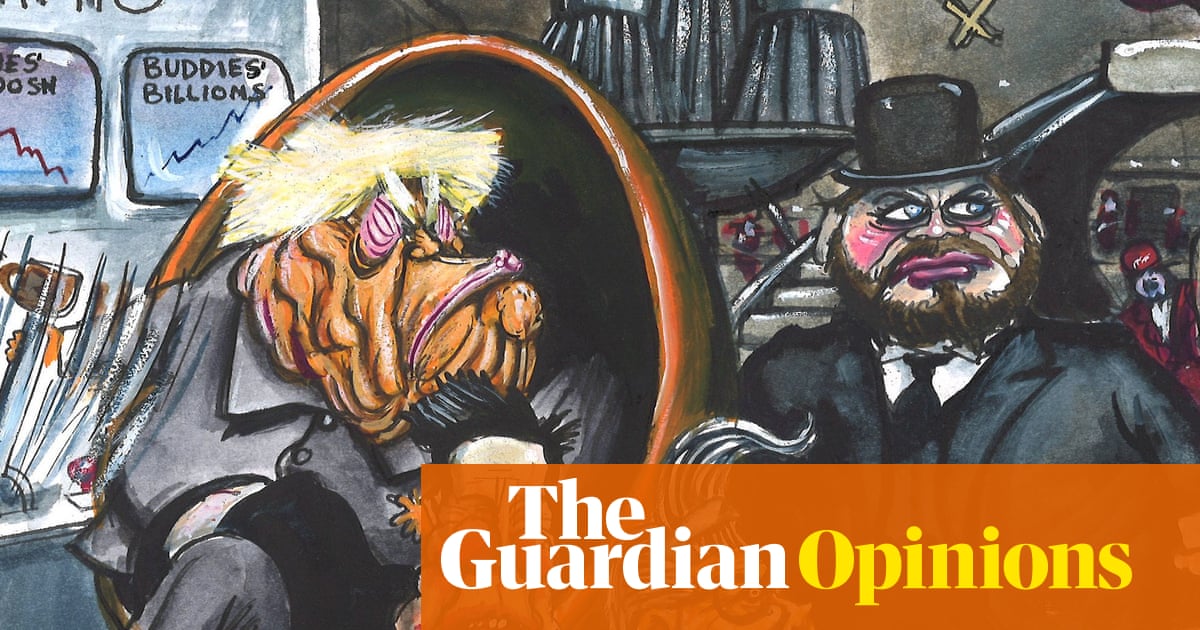
"In a year in which I've drawn too many cartoons about powerful people acting with impunity, the fall of Andrew Mountbatten-Windsor stood out to me as a rare win for justice and accountability. Dark humour feels vital to make light of everything that's going wrong, but I've also been trying to draw cartoons that highlight reasons for hope, such as the fragile ceasefire in Gaza or Zohran Mamdani's win in New York."
"In 40 years of cartooning I've never known such an anonymous government, where nobody recognises 95% of the cabinet (apart from Wes face like a full Brazilian Streeting). Whether this is down to Morgan McSweeney's shenanigans or them keeping their heads down until the day the nightmare ends doesn't matter: it's a tragedy. The wasted comic potential to be milked from Pat McFadden dead spit for Death from a Brueghel painting is a national disgrace."
"They are not people I want to spend my time thinking about, or looking at however nobody is beyond satire and they are both sufficiently unpleasant to make a good caricature. I loathe them, but I approach drawing them with curiosity and the eye of analysis. A caricature is as much about the person's expressions as it is about their features, and while Trump's face is very active, Putin's is still: only his mouth seems to move, so I go for his glare."
Political cartooning captured the tension between impunity and rare accountability, highlighting the fall of a powerful figure as a moment of justice. Dark humour served to illuminate failings while also spotlighting fragile positive developments such as a ceasefire in Gaza and an electoral victory in New York. A lack of recognisable cabinet figures produced an anonymous government that squandered satirical potential and provoked criticism. Satire remained focused on high-profile authoritarian leaders, using caricature to expose motivations through expressions and features and to ridicule those in power even when formal political change seemed unlikely.
Read at www.theguardian.com
Unable to calculate read time
Collection
[
|
...
]