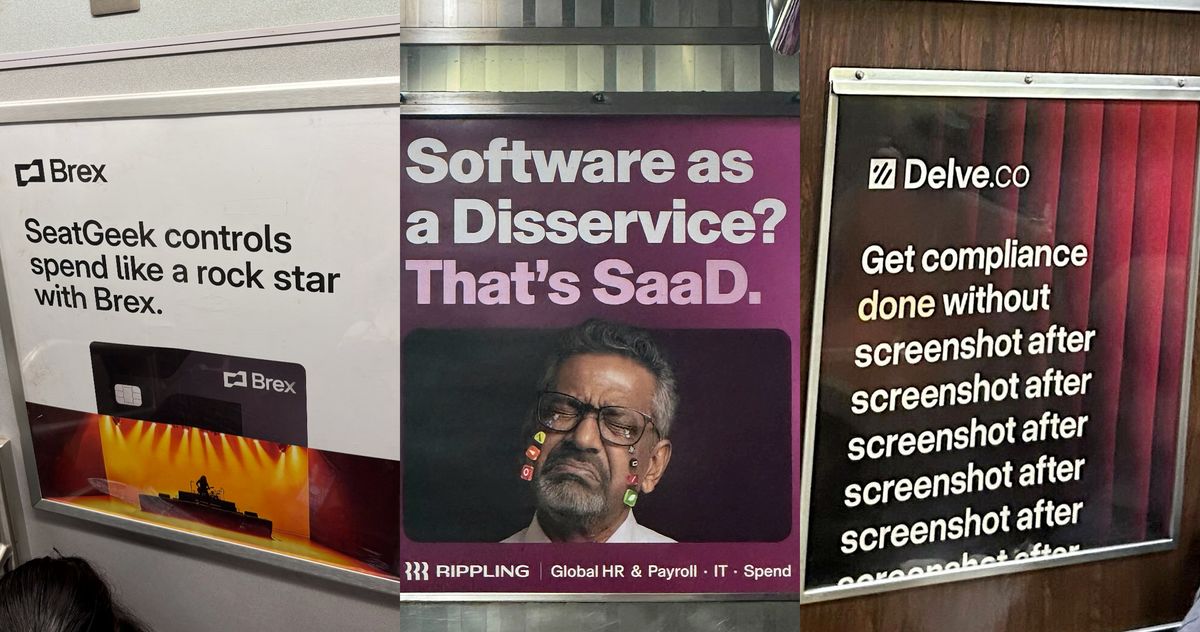
"I was riding the 5 train when I saw an ad above my seat for a company called Brex: "SeatGeek controls spend like a rock star with Brex." These words have the trappings of a sentence but do not mean anything together. I kept repeating them, like focusing my eyes on an optical illusion and waiting for something to appear. Nothing."
"Then I noticed more nonsense subway ads. A banner for a company called Semgrep that reads "Big Number Go Down. Code Security without the noise." Another: "Every artist has a medium. GTM has clay." Or Rippling and its crying man: "Software as a Disservice? That's SaaD." You might think to yourself: Am I insane? You are not. Marketspeak took over MTA ad space this year."
"Business-to-business products, many of them with an AI bent that do (do?) things (things?) like "go to market" or "eliminate developer friction." They are intended for an audience of people with titles like "chief people helper" or "director of employee experience." Wendy Liu, a writer and former software engineer, calls this phenomenon, which has already taken over the Bay Area, "B2B slop." It's almost a given that most public-transit riders aren't tech executives or VPs of human resources."
Commuter train advertising increasingly features opaque B2B marketing phrases from tech companies and startups. Ads display catchy but semantically empty slogans like "controls spend like a rock star," "Big Number Go Down," "GTM has clay," and "Software as a Disservice? That's SaaD." The language targets niche buyers with titles such as chief people helper and director of employee experience while remaining meaningless to most transit riders. The phenomenon has been labeled "B2B slop" and appears in major markets beyond the Bay Area. The trend reflects marketing choices driven by optics and hope rather than clear product communication, and transit ad inventory shows growing demand for such campaigns.
Read at Curbed
Unable to calculate read time
Collection
[
|
...
]