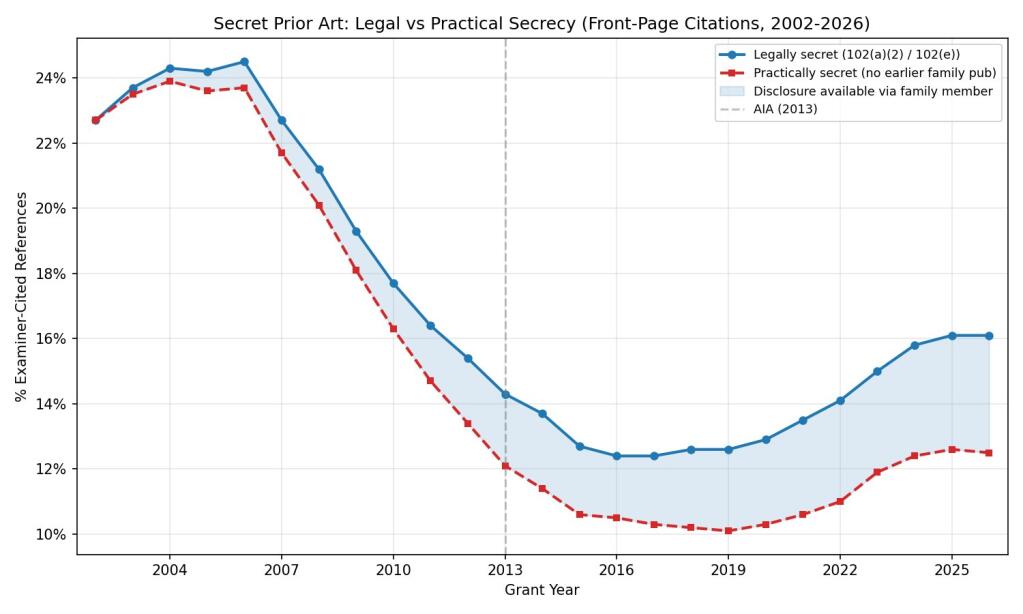
"Nearly 30% of office action rejections now cite at least one legally secret reference, up from about 20% a decade ago. This indicates a growing issue in patent applications."
"Many of the references cited as 102(a)(2) 'secrets' are continuations or divisionals whose parent application was already published, complicating the understanding of prior art."
"A diligent searcher could have found the substance of the reference at the time of filing, even if not the exact document, highlighting the nuances in prior art searches."
"The distinction between practically secret and legally secret references is crucial for understanding the true impact of unpublished applications on patent rejections."
Patent applicants often conduct prior art searches, but some references remain undiscovered until published. These 'secret springing prior art' references can retroactively affect patent applications. The measure of secret prior art is complex, with nearly 30% of office action rejections citing at least one legally secret reference. However, many cited references are continuations or divisionals of previously published applications, making the practical impact of secret references less severe than the legal definition suggests. A classification system distinguishes between practically secret and legally secret references.
Read at Patently-O
Unable to calculate read time
Collection
[
|
...
]