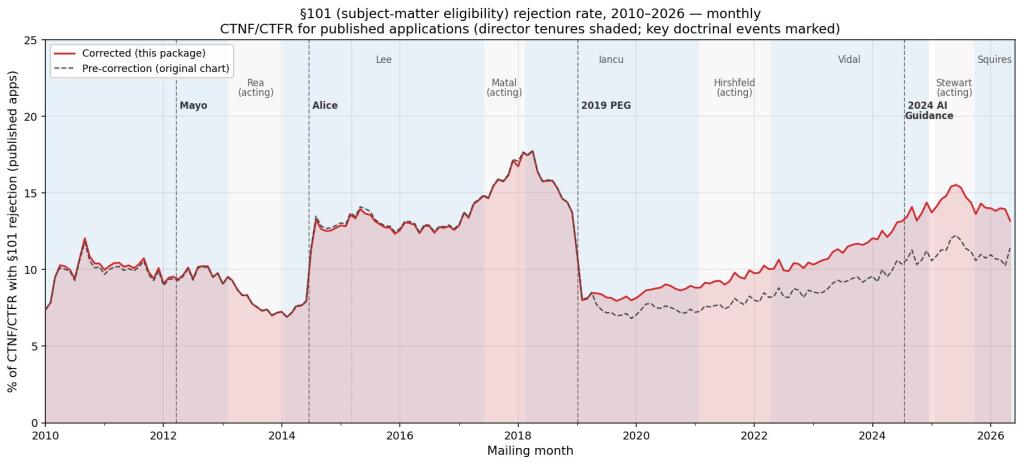
Optical-character-recognition failures on the longest office actions and missing rejections from the bulk USPTO dataset were corrected by reprocessing the full series through May 15, 2026. The corrected rejection-rate series closely matches the original through early 2019, then diverges afterward with a widening gap through 2024 and 2025. The post-2019 recovery is substantially larger than previously shown, bringing the rejection rate back to roughly 15.5% by mid-2025, near the earlier pre-PEG peak. The most recent decline during the Stewart and Squires tenures is also larger than originally indicated, but it remains small compared with the larger post-2019 trajectory.
"Two errors: the optical-character-recognition (OCR) step had been silently failing on the longest office actions, and the bulk USPTO dataset itself had dropped a substantial number of rejections that I then reconstructed using the USPTO API (pulling and parsing each retrieved action individually). I have now reprocessed the full series through May 15, 2026 (adding an additional week of data). The corrected chart does not disturb the central thesis, but it does provide additional insight."
"The chat here shows the corrected series (solid) against the original, pre-correction version (dashed). The two are nearly identical through early 2019 but then diverge afterward, with the gap widening through 2024 and 2025. What you see here is that the post-2019 recovery is substantially larger than my original chart showed, carrying the rejection rate back up to roughly 15.5% by mid-2025, within striking distance of the pre-PEG peak."
"The most recent decline, running through the Stewart and Squires tenures, is also larger than the original series indicated, though it remains small set against the size of the post-2019 trajectory."
Read at Patently-O
Unable to calculate read time
Collection
[
|
...
]