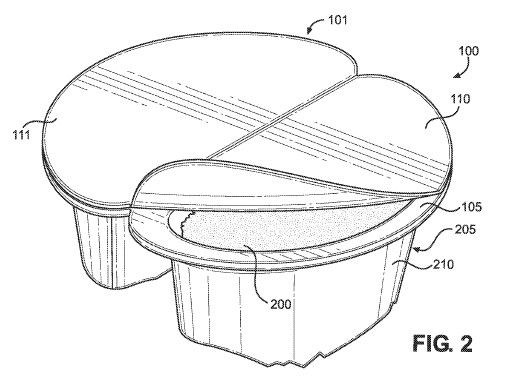
"The Federal Circuit affirmed a PTAB obviousness rejection in In re Blue Buffalo Enterprises, Inc., No. 2024-1611 (Fed. Cir. Jan. 14, 2026), holding that the claim terms " configured to" and " configured for" mean "capable of" performing the recited function absent specification language suggesting a narrower construction. The nonprecedential decision, authored by Chief Judge Moore and joined by Judge Taranto and visiting District Judge Chun, rejected the applicant's argument that "configured to" should be construed as "specifically designed to" perform the claimed function."
"Blue Buffalo's application claimed a wet pet food packaging container with deformable sidewalls and an integrated tool portion for tenderizing food. The claim recited sidewalls " configured to be readily deformable" and the integrated tool having projections " configured for use in breaking up and/or tenderizing the food product." The Board construed both phrases as requiring only that the structures be capable of performing these functions, which allowed the Coleman prior art reference to anticipate the limitations."
The Federal Circuit affirmed a PTAB obviousness rejection, holding that claim phrases "configured to" and "configured for" require only that structures be capable of performing the recited function unless the specification indicates a narrower meaning. The patent application claimed a wet pet food packaging container with deformable sidewalls and an integrated tool portion having projections for tenderizing food. The Board found the Coleman prior art anticipated the limitations under the "capable of" construction. The patentee conceded it was not challenging obviousness under that construction and focused its appeal solely on claim construction. The use of "configured to" has grown as a functional drafting tool, creating legal uncertainty.
Read at Patently-O
Unable to calculate read time
Collection
[
|
...
]