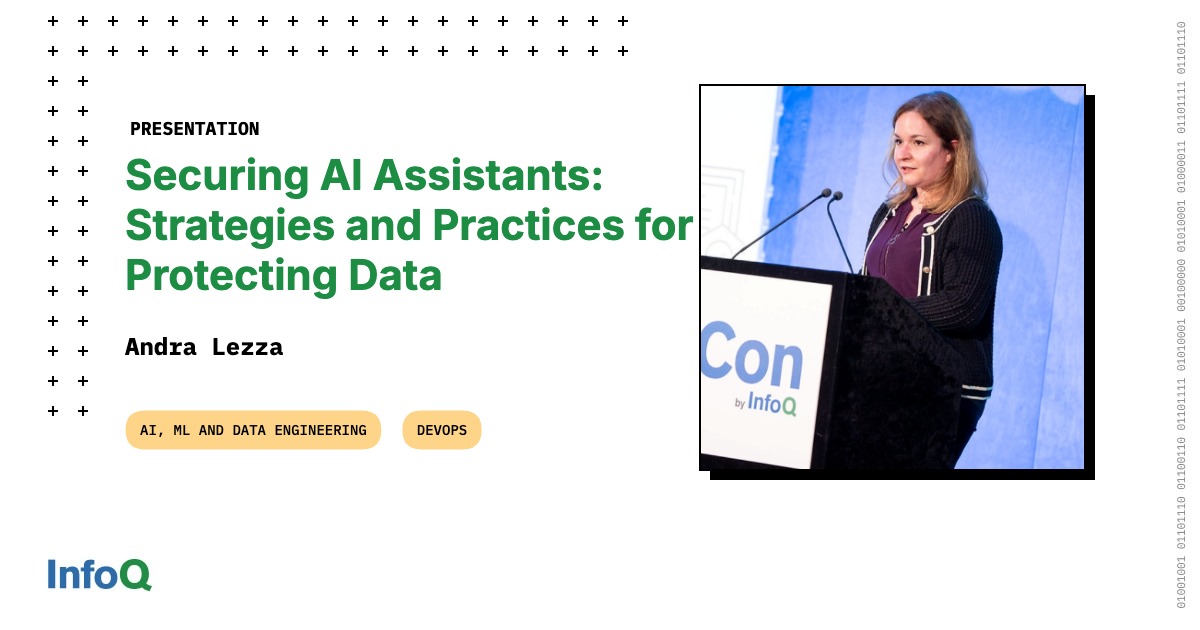
Securing AI assistants requires protecting the sensitive data that powers them across the entire pipeline. Focus areas include data ingestion, transformation, storage, deployment, and continuous monitoring with security controls. Copilots and assistants often access backend systems and external products, increasing exposure and complexity. Threat modeling frameworks such as the OWASP AI Exchange and comparisons like OWASP Top 10 for LLMs versus web apps inform risk identification. Implementations need per-component threat listings and controls for data leakage, access management, and ongoing monitoring. Continuous evaluation and tailored controls are necessary to maintain confidentiality and operational safety.
"Andra Lezza: My name's Andra. We'll talk about some of the technical aspects of securing AI assistants, tools that as we obviously see are becoming rapidly the nerve center of all operations within our companies. I'll focus on how to protect the data that powers these systems. I'll address everything from the initial ingestion of data and transformation, all the way to the deployment and continuous monitoring and security controls."
"We begin to encounter AI assistants everywhere, in more and more development workflows, chatbots, and so on, so securing the sensitive data throughout the pipeline becomes mission critical. You can think of it as a very simple solution. You have a copilot or an assistant, and it's simply able to answer questions based on our data and whatever account we're using. In reality, it's way more complicated than that, and it is very difficult to keep things simple. Most of these copilots will end up"
Read at InfoQ
Unable to calculate read time
Collection
[
|
...
]