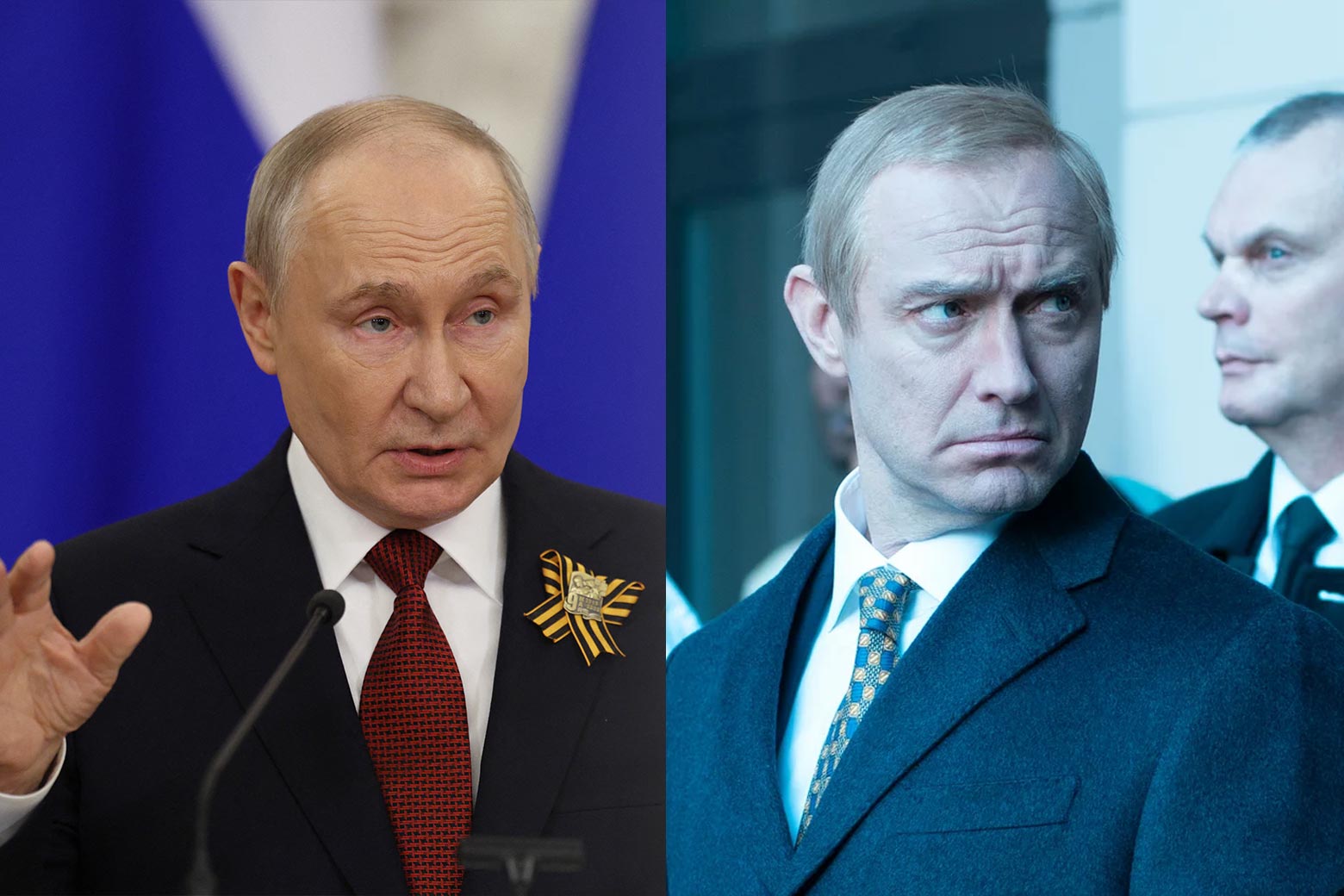
"The Wizard of the Kremlin is the story of Vladimir Putin's rise to and consolidation of power as seen through the eyes of his chief special adviser, a character based on Vladislav Surkov, who was a key architect of Putin's "managed democracy." He was also once known as the Russian leader's "gray cardinal," thanks to his ability to orchestrate events from behind the scenes."
"Given that the film is based on a novel, not a biography, it would be unrealistic to expect it to be entirely faithful to the facts. Indeed, director/co-screenwriter Olivier Assayas has said that Surkov and "Vadim Baranov," the film's stand-in for him, "cannot be mistaken for one another. Surkov is obnoxious; our Baranov, while complicit in the worst actions of the regime and somewhat perverse, retains a certain humanity.""
"Unfortunately, the result is that Baranov seems less like a Machiavellian media manipulator adept at developing inventive uses of new technology to strengthen authoritarian control and more like a particularly efficient chief of staff given to philosophizing about the nature of power. Moreover, Assayas has admitted that the characters the film was able to portray most accurately were those who are deceased, like the late Russian media mogul Boris Berezovsky, whose depiction, he said, "is as close to the truth as possible"."
""With other figures, we remain under strict legal scrutiny, so at times we've had to soften certain portrayals to avoid the risk of defamation." Nevertheless, he asserted, his intention was "to stay as close to the facts as possible, even though we were adapting a novel that itself takes some, albeit measured, liberties.""
A film portrays Vladimir Putin’s rise and consolidation of power through the perspective of a chief special adviser modeled on Vladislav Surkov, known for orchestrating events behind the scenes in a managed democracy. The story is adapted from a novel that is fictional yet inspired by real people and events. Because the source is not a biography, the film does not aim for complete factual fidelity. The stand-in character is described as more human than Surkov, shifting emphasis from media manipulation to a more philosophical view of power. Characters who are deceased can be depicted more directly, while living figures require softened portrayals to avoid defamation risk, even while the filmmakers aim to stay close to facts.
Read at Slate Magazine
Unable to calculate read time
Collection
[
|
...
]