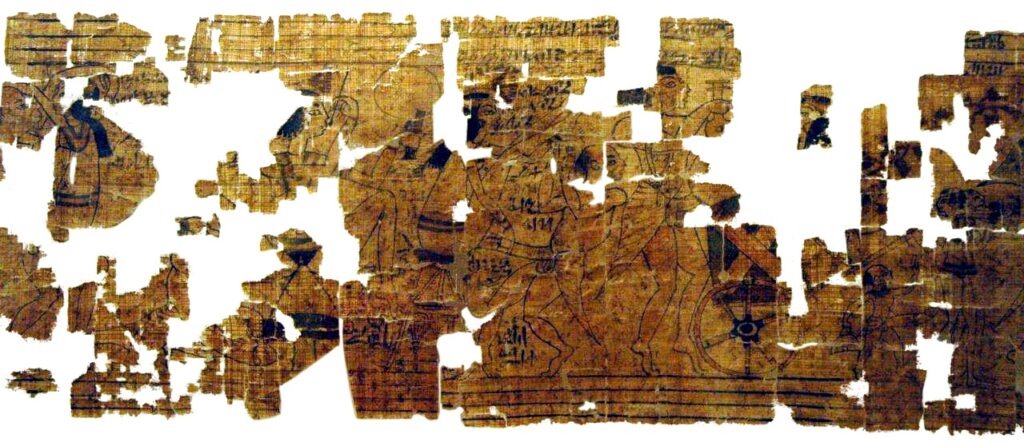
"Painted sometime in the Rameside Period (1292-1075 B.C.E.), the fragments above-called the "Turin Erotic Papyrus" because of their "discovery" in the Egyptian Museum of Turin, Italy-only hint at the frank versions of ancient sex they depict (see a graphic partial reconstruction at the bottom of the post-probably NSFW). The number of sexual positions the papyrus illustrates-twelve in all-"fall somewhere between impressively acrobatic and unnervingly ambitious," one even involving a chariot."
"Apart from its obvious fertility symbols, writes archaeology blog Ancient Peoples, the papyrus also has a "humorous and/or satirical" purpose, and probably a male audience-evidenced, perhaps, by its resemblance to 70's porn: "the men are mostly unkempt, unshaven, and balding [...], whereas the women are the ideal of beauty in Egypt." In fact the erotic portion of the papyrus was only made public in the 1970s. Egyptologists have known of the larger scroll, technically called "Papyrus Turin 55001" since the 1820s."
The Turin Erotic Papyrus dates to the Ramesside Period (1292–1075 B.C.E.) and contains explicit erotic imagery. The surviving fragments illustrate twelve sexual positions, some acrobatic and one involving a chariot. The imagery pairs fertility symbols with humor and satire and likely catered to a male audience given its characterizations of men and women. The erotic portion entered public view in the 1970s, while the larger scroll known as Papyrus Turin 55001 has been known since the 1820s. The non-erotic side depicts animals performing human roles as musicians, soldiers, and artisans, possibly representing archetypal traits of tradesmen.
Read at Open Culture
Unable to calculate read time
Collection
[
|
...
]