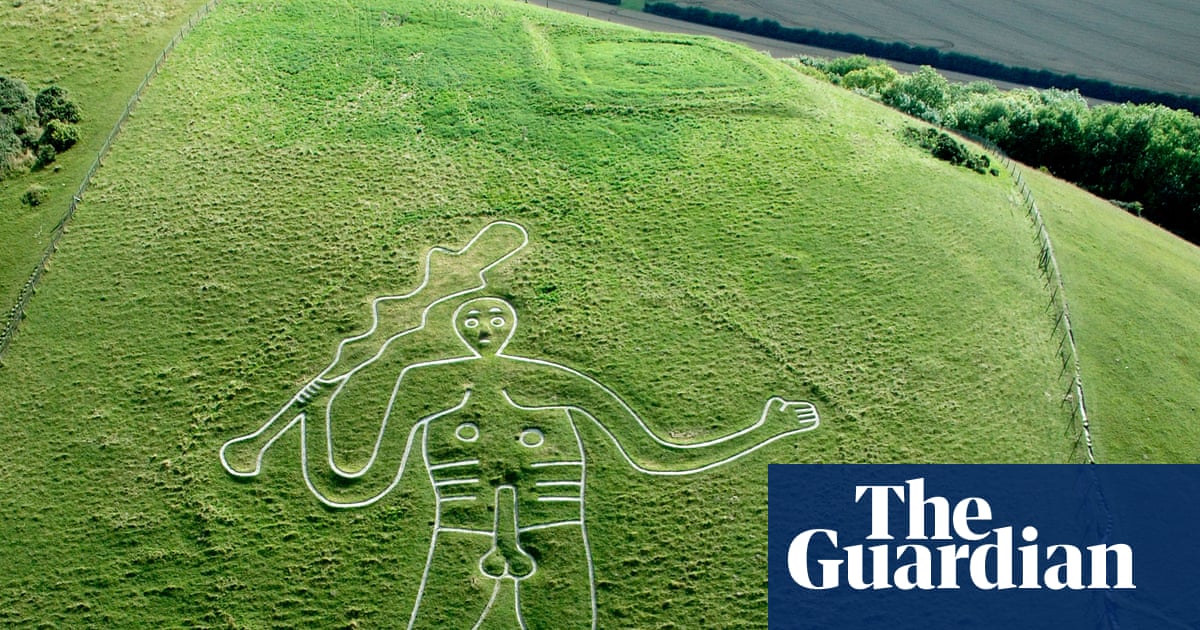
"The Long Man may be Anglo-Saxon in origin; the shape is similar to the design on a buckle discovered in Kent in 1964 by the archaeologist Sonia Chadwick Hawkes, which probably represents the god Odin (or Woden)."
"His form entranced the photographer Lee Miller and her husband, the artist Roland Penrose, who lived close to the Long Man. Penrose painted a surrealist representation of the Long Man on the inglenook fireplace at Farleys, their home; for them, the figure was a protective spirit."
"The Long Man of Wilmington is one of the more famous chalk figures, the mysterious carvings that decorate the hills in England, numbering 40 or so."
"They have always been a part of my life. Familiar and simultaneously fantastic, they have fascinated me and many others: film-makers, writers, musicians and artists."
The Long Man of Wilmington, located in East Sussex, is a chalk figure that may date back to Anglo-Saxon times. Its design resembles a buckle linked to the god Odin. The figure has inspired various artists, including Lee Miller and Roland Penrose, who viewed it as a protective spirit. The Long Man is part of a collection of around 40 chalk figures in England, which have intrigued many, including filmmakers, writers, and musicians, throughout history.
Read at www.theguardian.com
Unable to calculate read time
Collection
[
|
...
]