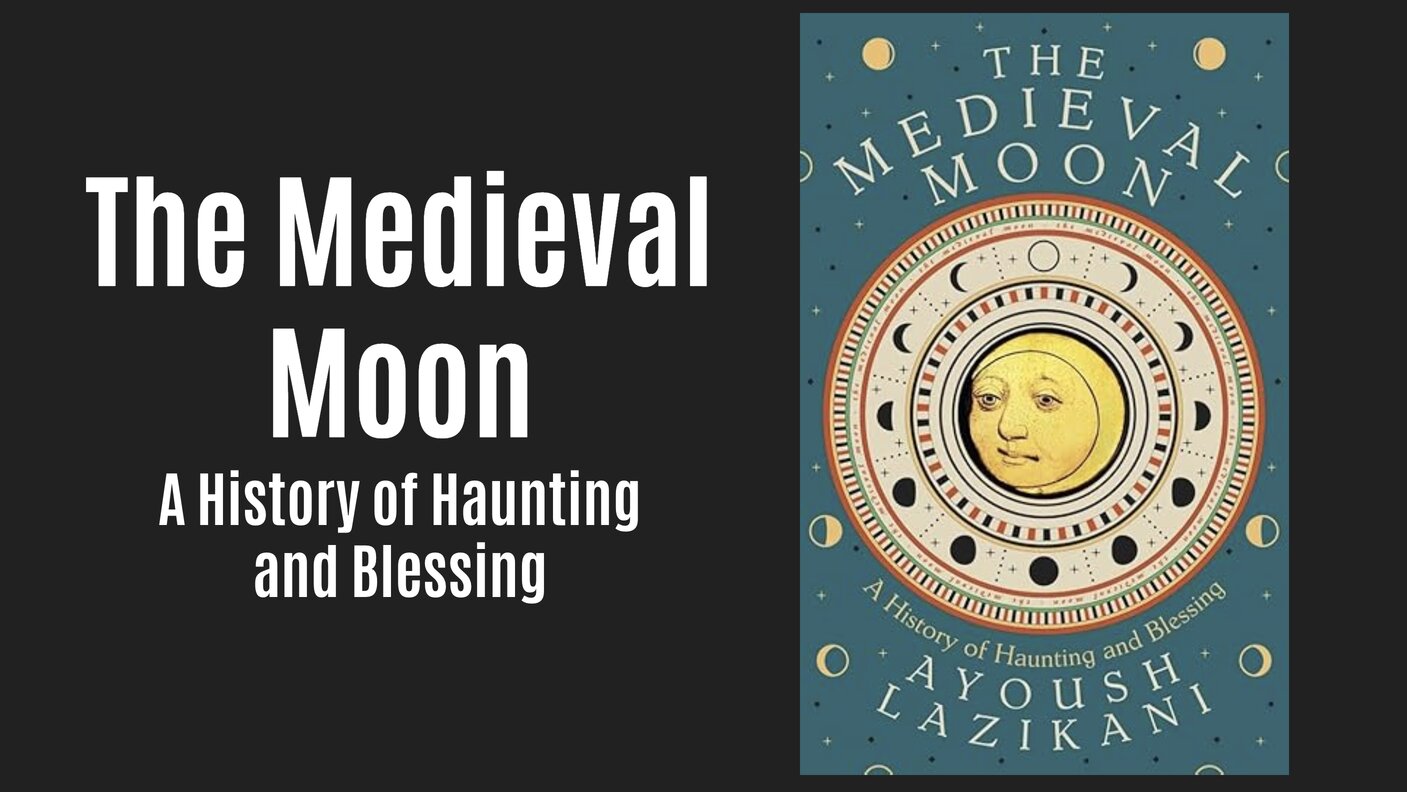
"In this book of moons, I am writing for people for whom the medieval world and its literatures and arts may be unfamiliar. I hope that in telling the stories of medieval moons, I also introduce these readers to the wonderful, mesmerising realm of medieval texts and images. But I also hope that this book may be useful to those with greater familiarity with medieval languages, literatures, and arts."
"Yet The Medieval Moon delivers far more than just a thematic overview of the moon that bridges disciplinary siloes. Lazikani refreshingly challenges the conventional periodisation of the Middle Ages by taking the story forward to 1600 (on the basis that astronomical perceptions of the moon did not change significantly until the 17th century) and, more importantly, offers a genuinely global vision of the period, taking in Japanese, Polynesian, and Mayan culture."
Medieval cultures interpreted the moon through scientific learning, literature, art, faith, and folklore, integrating lunar phenomena into social and intellectual life. The moon informed astronomical knowledge and calendar practices while inspiring poetic, visual, and religious imagery across regions. Cross-cultural perspectives span Europe, Japan, Polynesia, and the Americas, revealing both local variations and shared symbolic meanings. Moon-related narratives shaped beliefs about blessing, haunting, temporality, and human behavior. The medieval lunar imaginary persisted into the early modern period, with major shifts in astronomical perception only appearing in the seventeenth century. The moon functioned as a lens onto broader cultural exchanges and material practices.
Read at Medievalists.net
Unable to calculate read time
Collection
[
|
...
]