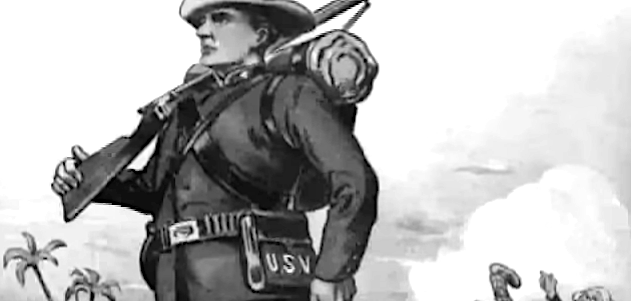
""Through­out U.S. his­to­ry, our mil­i­tary has been used not for moral pur­pos­es but to expand eco­nom­ic, polit­i­cal, and mil­i­tary pow­er," says a car­toon Howard Zinn in Mike Konopacki's 273-page com­ic book A People's His­to­ry of Amer­i­can Empire. Writ­ten with Zinn and his­to­ri­an Paul Buh­le, the book adapts Zinn's path­break­ing his­to­ry from below, A People's His­to­ry of the Unit­ed States, and his auto­bi­og­ra­phy You Can't Be Neu­tral on a Mov­ing Train in a direct exam­i­na­tion of the U.S. Imperi­um. Konopac­ki calls the book his "answer" to the text­books of "the pow­er struc­ture.""
"Above, you can see a short video adap­ta­tion of some key text from A People's His­to­ry of Amer­i­can Empire. Nar­rat­ed by Vig­go Mortensen, the video gives us a nut­shell ver­sion of Zinn's cul­tur­al, polit­i­cal, and moral education-what the Ger­mans used to call bil­dung -as he grows from a some­what naive WWII bomber pilot, to a col­lege stu­dent on the G.I. Bill, to a grad­u­ate stu­dent, then pro­fes­sor, of his­to­ry. Along the way he notices that the map in every text­book labeled "West­ern Expan­sion" shows "the march across the con­ti­nent as a nat­ur­al, almost bio­log­i­cal phe­nom­e­non":"
The U.S. military has been portrayed as serving expansion of economic, political, and military power rather than moral purposes. A 273-page graphic adaptation combines a people-centered historical perspective and autobiographical material into a direct critique of U.S. imperialism. A short narrated video compresses a life trajectory from WWII bomber pilot to historian, illustrating cultural, political, and moral formation. School maps labeled "Western Expansion" are critiqued for presenting conquest as natural and erasing the presence of hundreds of Indigenous nations. The Louisiana Purchase is shown as dispossession, forced removal, and ethnic cleansing rather than empty land acquisition.
Read at Open Culture
Unable to calculate read time
Collection
[
|
...
]