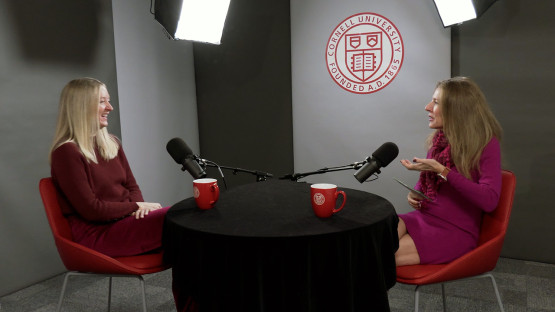
Cornell launched a video podcast called Research Matters to make connections between academic research and everyday problems visible and accessible to a broad public audience. The program features conversations that translate complex scholarship into casual language for listeners of all backgrounds. Episodes address real-world challenges including climate change, public safety, mental health, food systems, and technological futures. Early installments examine how subtle cues influence 911 caller treatment, how fats and inflammation can fuel cancer and exacerbate disparities, and other applied research with implications for policing, emergency response, public health, and agricultural systems. The initial release includes three episodes on Jan. 27.
"Launching Jan. 27 with three episodes, "Research Matters" spotlights Cornell scholars whose research directly engages with real-world challenges, from climate change and public safety to mental health, food systems and the future of technology. Hosted by Cornell Chronicle staff writer Laura Reiley and produced by Garth Avery, broadcast studio specialist in Media Relations, the series translates complex scholarship into casual conversations that can be understood by listeners of all backgrounds."
""This series is about showing why research matters on campus and beyond," said Monica Yant Kinney, associate vice president for university relations. "Cornell's researchers are deeply engaged with the world as it is - and as it could be. 'Research Matters' gives them space to explain not just what they're studying, but why it matters now.""
"In one installment, psychologist Jessica Salerno, associate professor in the College of Human Ecology and Cornell Law School, discusses how subtle cues like tone or emotional expression can affect whether 911 callers are treated as victims or suspects. Her work has implications for policing, bias and emergency response systems nationwide. In another episode, biomedical scientist Dr. Glenn E. Simmons Jr. , assistant professor in the College of Veterinary Medicine, reveals how fats and inflammation can fuel cancer - and why some communities face worse outcomes than others ."
Read at Cornell Chronicle
Unable to calculate read time
Collection
[
|
...
]