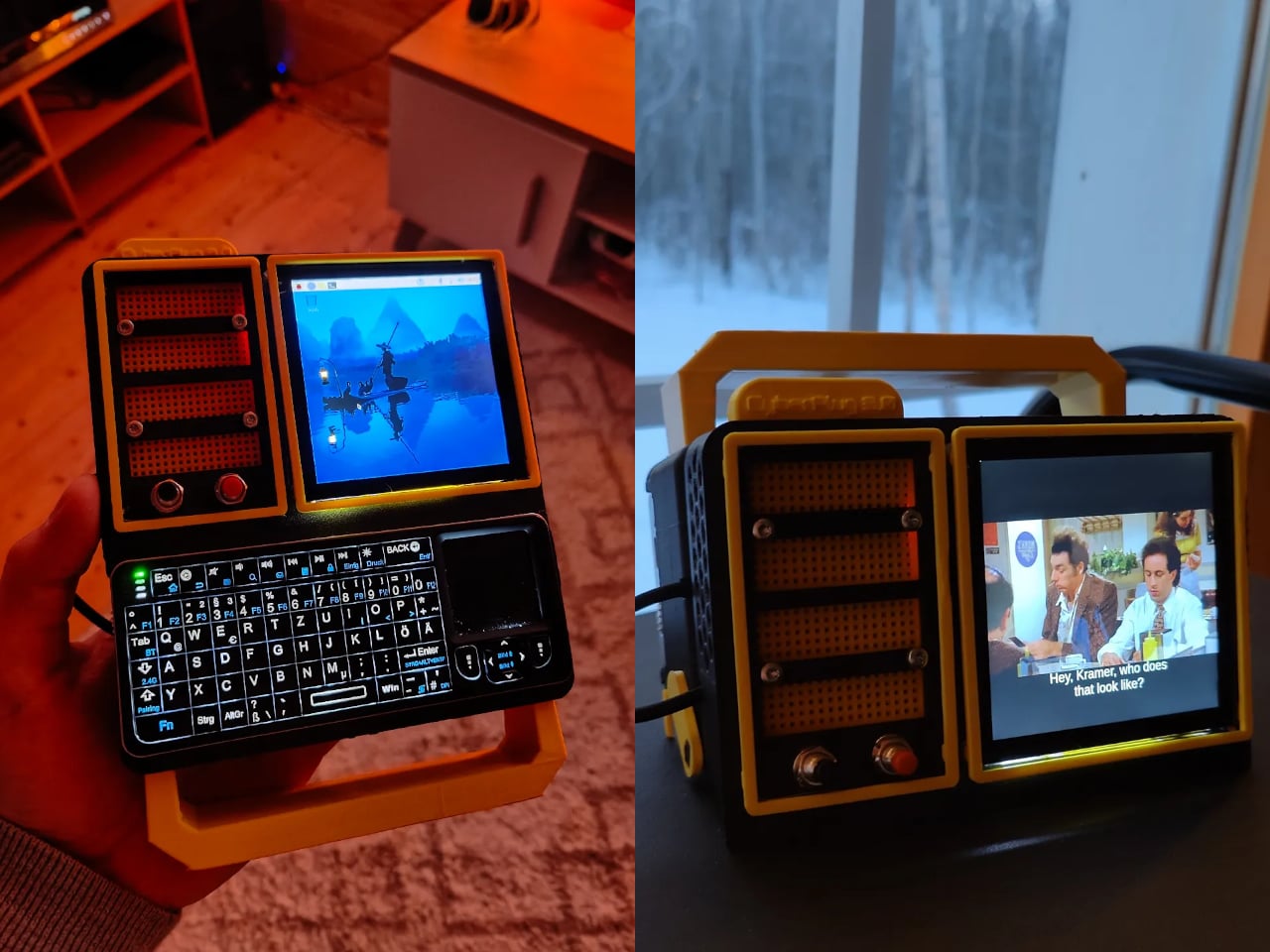
"What separates this from a standard Raspberry Pi build is the pair of breadboards soldered directly to the GPIO pins, seated inside the case, and accessible through a removable back panel. Connecting a sensor no longer means hunting for a separate breadboard and a tangle of jumper wires. PickentCode plugged in a temperature and humidity sensor and had it reading live data within minutes."
"The two form factors each have a distinct locking mechanism rather than just flopping into position. In handheld mode, twin magnets pull the two halves together. In desktop mode, a metal ring on the back grabs the MagSafe-style power bank magnetically, holding the whole thing at a stable upright angle."
"Most portable computers are sealed boxes, which is exactly what makes them frustrating for anyone who wants to experiment with electronics. You can run code on a laptop, but try wiring a temperature sensor or an infrared transmitter directly to it, and you'll realize that consumer hardware was never designed for that kind of access."
CyberPlug 3.0 addresses the limitation of sealed consumer laptops by providing a portable platform for electronics experimentation. The device combines a Raspberry Pi 4, 4-inch touchscreen, mini keyboard, and 5,000 mAh power bank in a 3D-printed hinged case. Integrated breadboards soldered to GPIO pins eliminate the need for separate breadboards and jumper wires, enabling rapid sensor integration. The design features dual form factors: handheld mode with magnetic closure and desktop mode with MagSafe-style magnetic positioning. Extensions include temperature-controlled fans and speaker modules, demonstrating expandability for custom projects.
Read at Yanko Design - Modern Industrial Design News
Unable to calculate read time
Collection
[
|
...
]