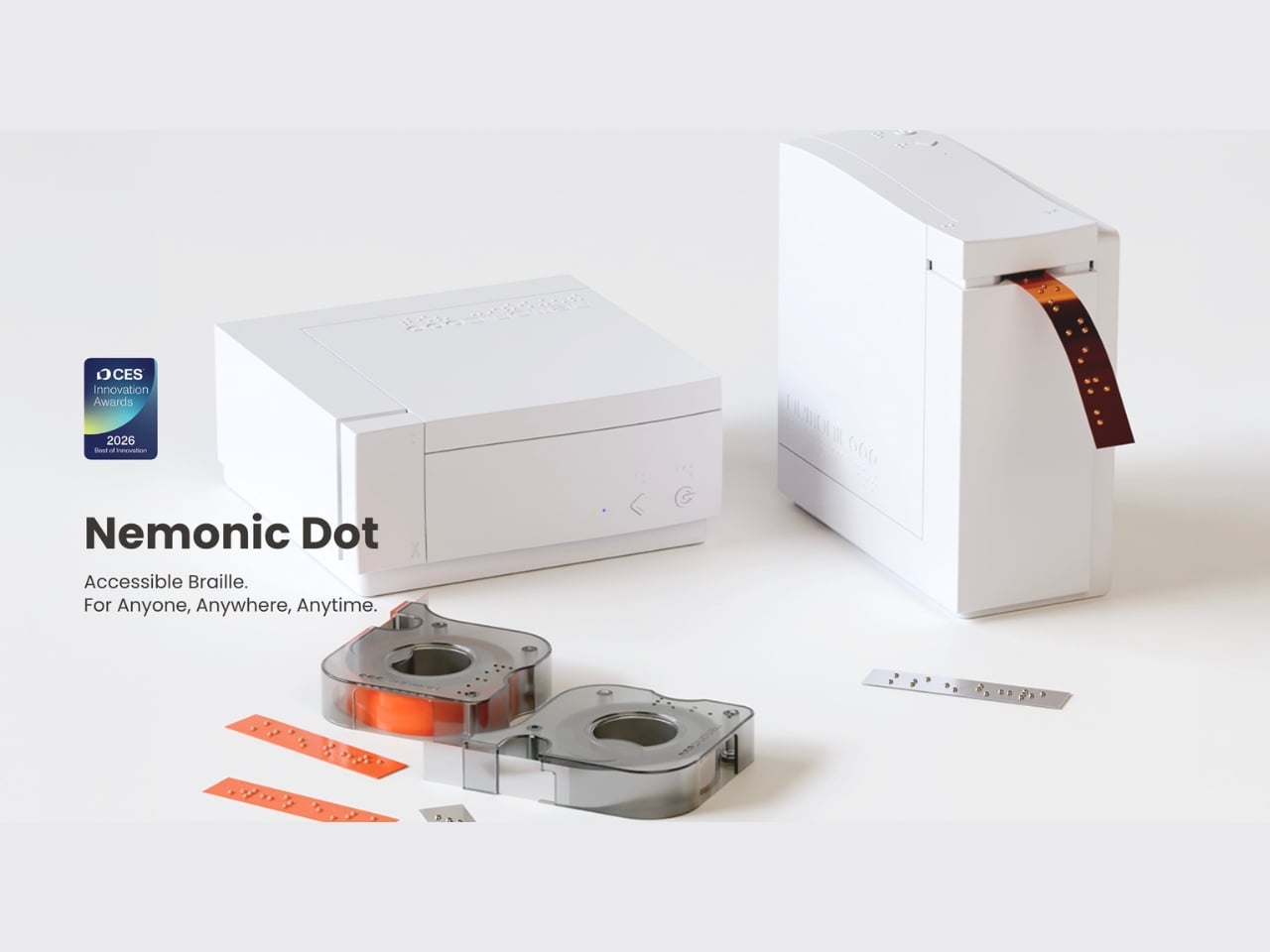
"Picture this: you're helping your grandmother organize her medicine cabinet, but she's visually impaired. Those prescription bottles all look identical to her touch. You want to help, but learning Braille isn't exactly something you picked up over coffee. Now imagine pulling out a compact printer, speaking into your phone, and watching as sticky Braille labels emerge, ready to paste onto each bottle. That's the beautiful simplicity behind Mangoslab's Nemonic Dot printer, unveiled at CES 2026."
"This isn't just another gadget trying to solve a problem nobody has. It's a genuinely thoughtful piece of design that bridges the gap between those who want to help and those who need it. The Nemonic Dot is roughly the size of a stack of drink coasters, a plastic square about 4.5 inches wide and 2 inches thick that connects wirelessly to your smartphone."
"The magic lies in the voice interface. You speak a word into the app, and it converts your speech into text, then translates that text into Braille, and finally prints it onto a peel-and-stick strip. No Braille keyboard required. No special training needed. Just your voice and a desire to make someone's daily life a little easier. It's the kind of intuitive design that makes you wonder why nobody thought of it sooner."
"Mangoslab, which spun off from Samsung's internal C-Lab research department years ago, originally made their name with a cute sticky note printer. But they've evolved that concept into something with real social impact. Traditional Braille label makers cost upward of $1,250 and require users to type directly in Braille using specialized keyboards. The Nemonic Dot comes in under $1,000 and eliminates that learning curve entirely."
The Nemonic Dot is a compact, square wireless printer roughly 4.5 inches wide and 2 inches thick that produces peel-and-stick Braille labels. A companion smartphone app uses voice input to transcribe spoken words, translate text into Braille, and print tactile strips without requiring Braille keyboards or training. The device supports multiple languages and Braille standards and targets affordable accessibility by costing under $1,000 compared with traditional Braille label makers priced above $1,250. The design aims to simplify caregiving tasks, enable non-Braille users to assist visually impaired people, and reduce barriers to everyday labeling through intuitive, speech-driven operation.
Read at Yanko Design - Modern Industrial Design News
Unable to calculate read time
Collection
[
|
...
]