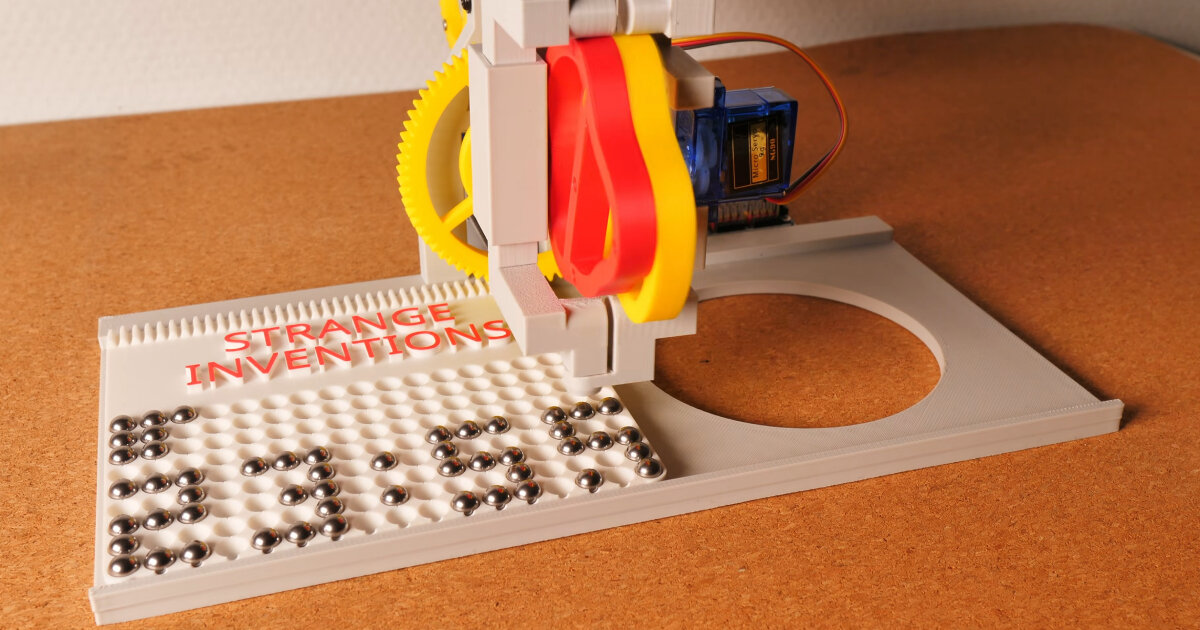
"The inspiration for the mechanical marble clock comes from Ivan Miranda, an engineer known for building enormous marble clocks at an almost architectural scale. The response project is quite the opposite, though, because the creator tries to see what the smallest, simplest, cheapest version of this idea could work."
"Almost the entire structure is 3D printed in polylactic acid, which is a plastic made from fermented plant starch, usually corn or sugarcane. While it's not the toughest material since it can warp or can crack along layer lines, it's suitable for a mechanical project like this, especially since it's lightweight enough to be moved anywhere."
"When the magnet drops and touches a marble, it picks it up. Then, a small separator ring pushes it down to scrape the marble free. There's no electromagnet or complex electronics needed. It's just geometry."
Strange Inventions designed a compact mechanical marble clock that displays time through steel balls arranged in pixel-like digits. The device, roughly the size of a chopping board, uses a robotic arm powered by hobby servo motors to move marbles one by one every minute. Nearly the entire structure is 3D printed from polylactic acid, a plant-based plastic that is lightweight and suitable for mechanical projects despite being less durable than other materials. The clock features a colorful design with gray and white as primary colors and red and yellow accents. A permanent magnet attached to a servo picks up steel balls, while a cam system converts rotational movement into precise push-and-pull motions. The time display uses a 3×5 pixel font, the smallest readable digit format, with each marble representing one pixel.
Read at designboom | architecture & design magazine
Unable to calculate read time
Collection
[
|
...
]