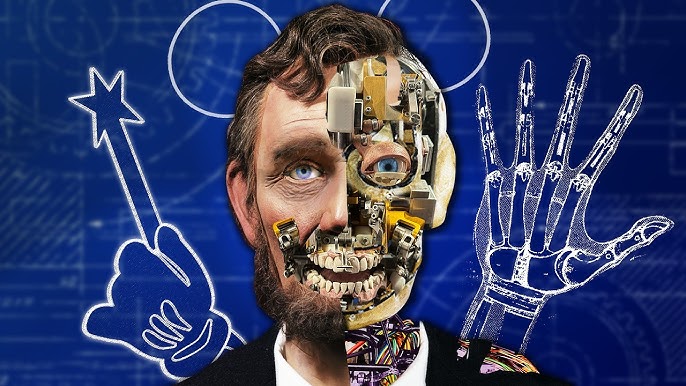
Young children thrill at seeing beloved characters in person, often provided by costumed cast members at Disney theme parks. Walt Disney imagined a future with reliable, untiring, perfectly lifelike robots replacing costumed performers. Disney's team built an audio-animatronic Abraham Lincoln able to stand and deliver a short speech. The figure appeared publicly at the 1964 New York World's Fair and provoked ethical and aesthetic controversy during development. Early technical difficulties were resolved and the effect proved convincing enough that some attendees mistook the figure for a costumed actor, wondering about the performer's endurance.
"For young chil­dren today, just as it was for gen­er­a­tions of their pre­de­ces­sors, noth­ing is quite so thrilling about their first vis­it to a Dis­ney theme park as catch­ing a glimpse of Mick­ey Mouse, Don­ald Duck, or anoth­er beloved char­ac­ter greet­ing them in real life. Cre­at­ing this mem­o­rable expe­ri­ence requires noth­ing more advanced than a well-trained employ­ee (or "cast mem­ber," as the com­pa­ny puts it) in an over­sized cos­tume. Nev­er­the­less, effec­tive though it may be, it was­n't part of Walt Dis­ney's long-term vision."
"In the event, Dis­ney only lived long enough to see his peo­ple cre­ate a mechan­i­cal ver­sion of Abra­ham Lin­coln, whose abil­i­ties were lim­ed to stand­ing up from his chair and deliv­er­ing a short speech. By the time that "audio-ani­ma­tron­ic" res­ur­rec­tion of the Unit­ed States' six­teenth pres­i­dent was first pub­licly shown at the 1964 New York World's Fair, its rumored devel­op­ment had already set off a num­ber of eth­i­cal and aes­thet­ic con­tro­ver­sies. Yet it worked so well"
Read at Open Culture
Unable to calculate read time
Collection
[
|
...
]