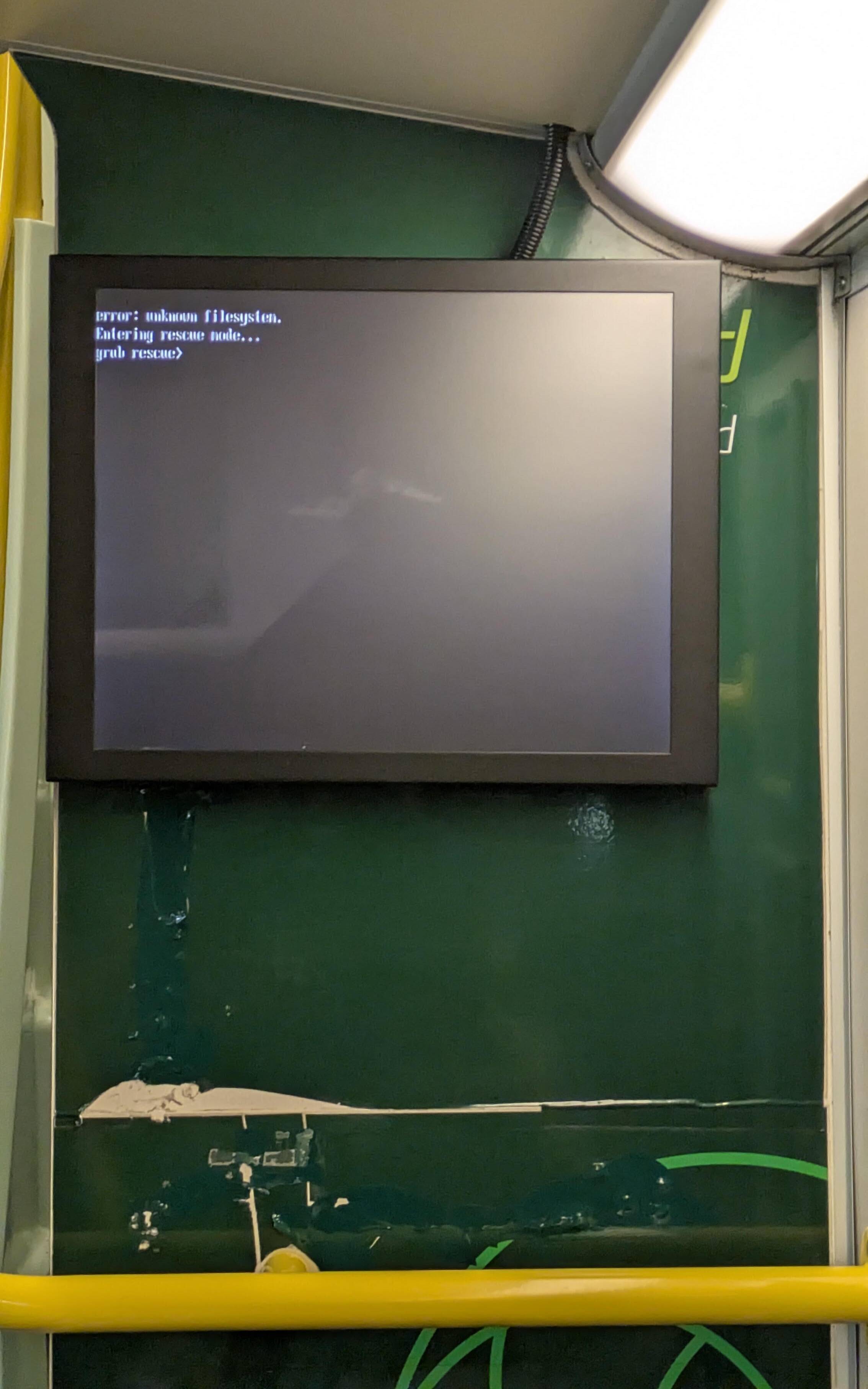
"Bork!Bork!Bork! Most people would be perfectly happy to ride the bus without seeing ads. So this latest public error could be a blessing in disguise for passengers, if not for the bus company hoping to make money. Love it or hate it, this bit of borked digital signage looks to have run into a problem that only an open-source hero can solve."
"Spotted by Register reader Jay, today's entry in the pantheon of bork is a screen bolted to a bus that has failed to boot. Indeed, a grub rescue prompt indicates that something has gone seriously awry. Judging by the state of the wall beneath the screen, there was likely some decidedly non-digital signage (a paper ad perhaps) stuck there initially. It was replaced with something a little more hi-tech, which has rewarded the passengers by showing them error messages rather than another annoying ad."
"In this instance, "Grub" probably refers to Linux's Grand Unified Bootloader, which many Linux distributions use to handle the system startup process. It fires up the Linux kernel and does the bare minimum to get the hardware operational. So not a sneaky late-night kebab. The rescue shell (which is where it looks like this bit of signage has left the passengers) can be used to repair a non-booting Linux system."
Digital signage on a bus failed to boot, presenting passengers with a GRUB rescue prompt instead of advertisements. The screen appears to have replaced earlier paper signage, leaving an inked or marked wall beneath. GRUB is the Grand Unified Bootloader used by many Linux distributions to initialize the kernel and hardware. The rescue shell can be used to identify partitions, locate the GRUB directory, and manually prompt the operating system to boot, but those steps require Linux familiarity and an input device. Lack of attached input hardware and limited passenger expertise make on-the-spot repair unlikely. The fault was reportedly rectified shortly afterward.
Read at Theregister
Unable to calculate read time
Collection
[
|
...
]