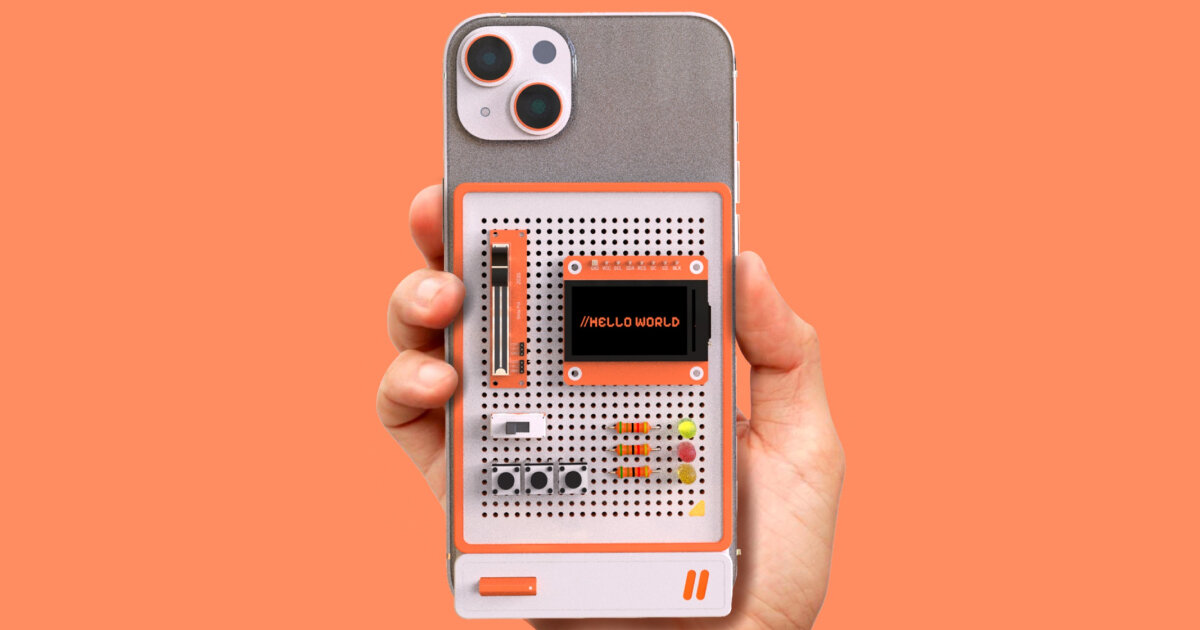
Commi Board is an attachable magnetic board that converts a smartphone into the main interface and processing unit for electronic prototyping. The board connects via USB-C or Bluetooth and lets users place components directly onto a modular surface. A dedicated app mirrors the physical circuit layout, guides connections, and displays errors during assembly to prevent trial-and-error. The phone simulates microcontroller behavior so users can write and run code without flashing external chips. Programming options include AI natural-language, visual blocks, Scratch-like logic, and a full IDE. Real-time feedback shows voltage states, logic changes, and circuit responses on the phone screen.
"A way to let people learn and practice electronics, the magnetic device brings prototyping, coding, and testing into a single system centered on a smartphone. Instead of asking users to buy computers, microcontrollers, and displays, Commi Board uses the phone as the main interface and processing unit. The attachable board for electronic prototypes also connects through USB-C or Bluetooth. Commi Board is modular, as users place electronic components directly onto the board."
"Connections are guided through a dedicated app, which reflects the physical layout of the circuit and helps users understand how components relate to code. Errors appear during the process rather than at the end to avoid a trial-and-error approach. A key design choice is simulation since instead of requiring a separate microcontroller for every test, the attachable board for electronic prototypes simulates microcontroller behavior using the phone's computing power."
"Programming is offered through four methods with the Commi Board. Users can write code using an AI-based natural language system, visual programming blocks, Scratch-like logic, or a fully integrated development environment. Beginners can start with guided logic and move toward text-based programming as their understanding grows since the system does not force a single learning path. Real-time feedback is central to how the design helps users."
#electronic-prototyping #smartphone-based-prototyping #microcontroller-simulation #educational-technology
Read at designboom | architecture & design magazine
Unable to calculate read time
Collection
[
|
...
]