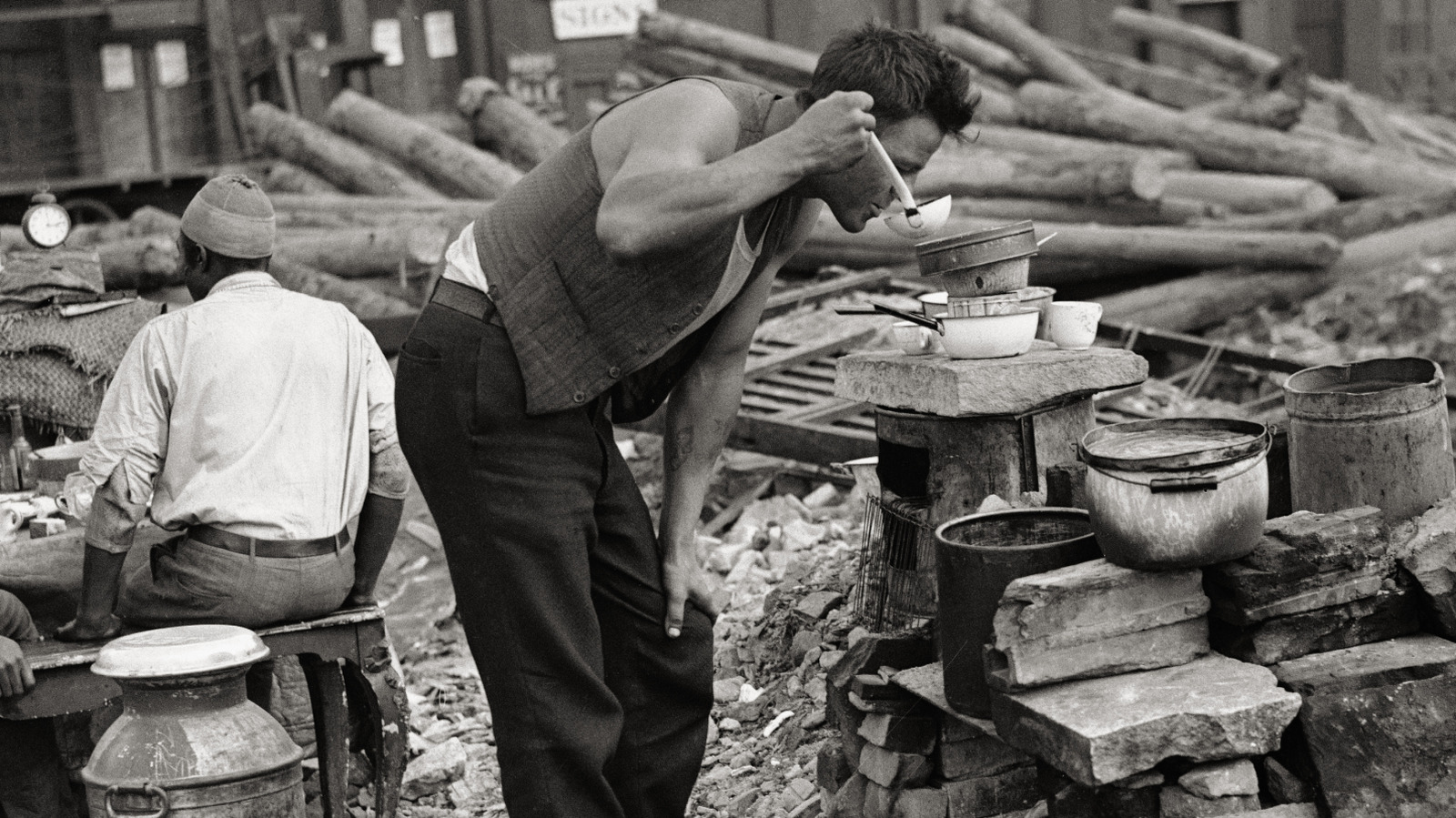
"Don't get it twisted - hobos, tramps, and bums are not the same. A "hobo" travels in search of gig work, while a "tramp" simply travels (not seeking work), and a "bum" neither travels nor works. Today, we're giving reprise to a beefy, vintage one-pot meal that deserves a comeback: Mulligan stew, a dish that largely emerged from the Depression Era's "hobo" culture."
"one person builds the fire, while another person is tasked with finding meat, and another finds potatoes, and on and on: "If a chicken can be stolen, so much the better. The whole outfit is placed in [a large can] and boiled until it is done. If one of the men is successful in procuring 'Java,' an oyster can is used for a coffee tank, and this is also put on the fire to boil.""
Hobos, tramps, and bums are distinct: a hobo travels seeking work, a tramp travels without seeking work, and a bum neither travels nor works. Mulligan stew originated in early 20th-century American hobo camps and became associated with the Depression Era. The name likely comes from the Irish slang "Mulligan," referring to an ordinary man. Hobo camps practiced an egalitarian division of labor for communal stew-making, using scavenged or stolen ingredients boiled together in large cans and improvised coffee containers. Mulligan stew functions as a concept—meat and vegetables stewed together—rather than a fixed recipe, with variations like coating beef in flour for richness and thickness.
Read at Tasting Table
Unable to calculate read time
Collection
[
|
...
]