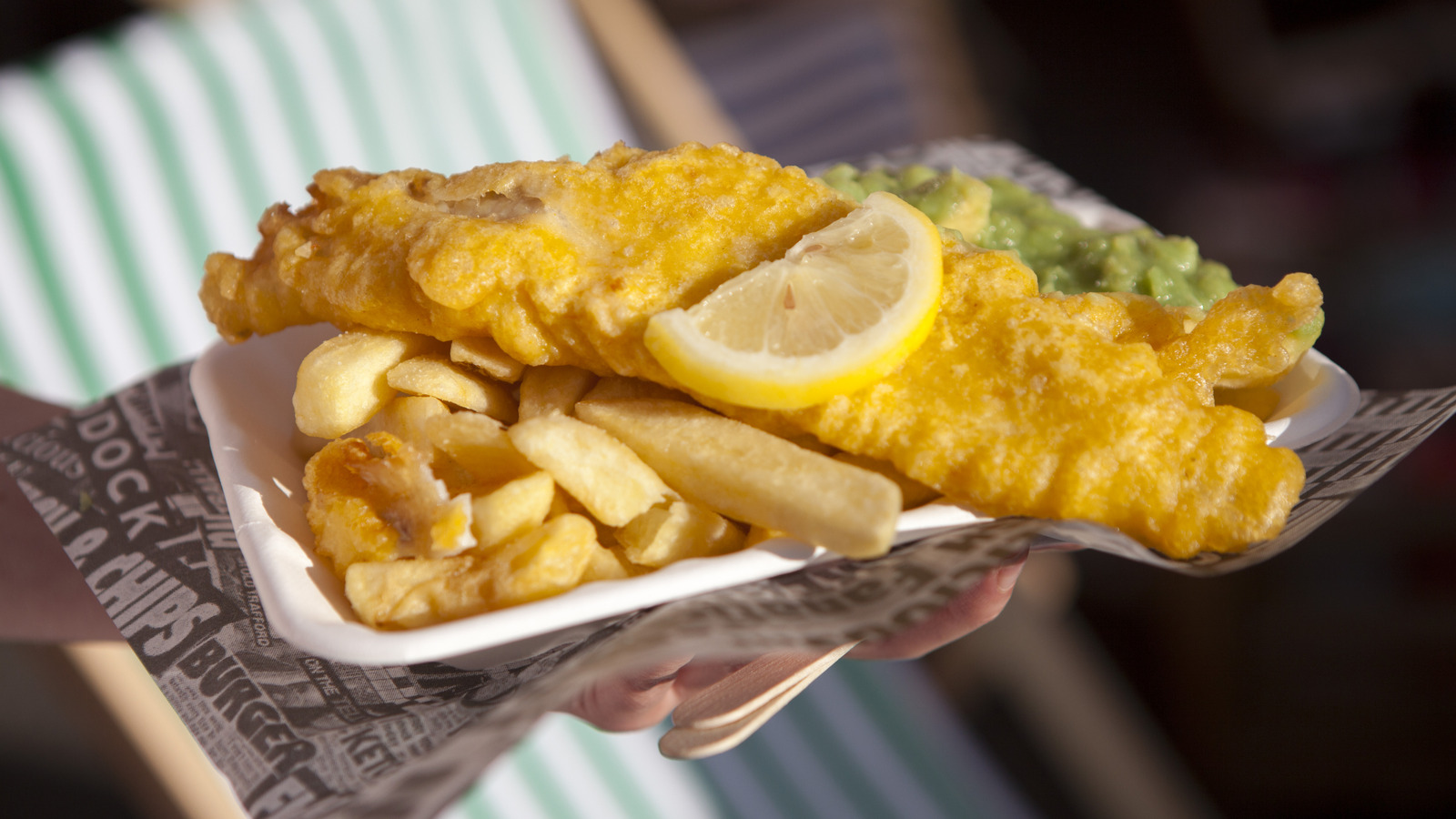
"You would be hard-pressed to think of a more iconic British food than fish and chips. While there are a number of other culinary icons from across the pond, such as beef Wellington and bangers and mash, the delicious simplicity of breaded and fried fish with french fries appeals to diners worldwide. But there's more to fish and chips than meets the eye. You can't just say British fish and chips, because the dish can be divided into English and Scottish variations."
"By and large, the English prefer salt and malt vinegar on their fish and chips. There's a little love for ketchup, curry, and even mayonnaise on the side, but those are some outliers. In Scotland, however, especially in the capital of Edinburgh, vinegar takes a backseat to HP brown sauce. This is often known as "chippy" sauce, or, in some circles, it's indistinguishable from steak sauce ( even though it's not exactly the same as A1)."
"Before we go further, it should be noted that proper Scottish chippy sauce is not technically just HP sauce. You have to dilute the brown sauce, often with vinegar, to make chippy sauce. So, it's ultimately a thinner version of HP and not typically something you would buy in a store. Instead, it's usually made and bottled by a Scottish chippy, chippie, or chipper, meaning a shop that specializes in fried foods."
Fish and chips represent an iconic British dish served in English and Scottish variations. English servings generally favor salt and malt vinegar, while Scottish servings often use a diluted HP brown sauce called chippy sauce. Proper chippy sauce is a thinner version of HP, commonly diluted with vinegar and typically made and bottled by individual chippies rather than sold in stores. Traditional fish choices are cod or haddock, and chips are very thick-cut with a fluffy interior and crispy exterior, similar to steak fries. Vinegar or brown sauce is poured over the chips or served on the side for dipping.
Read at Tasting Table
Unable to calculate read time
Collection
[
|
...
]